Halloween Countdown: ISLAND OF LOST SOULS

Island-of-Lost-Souls

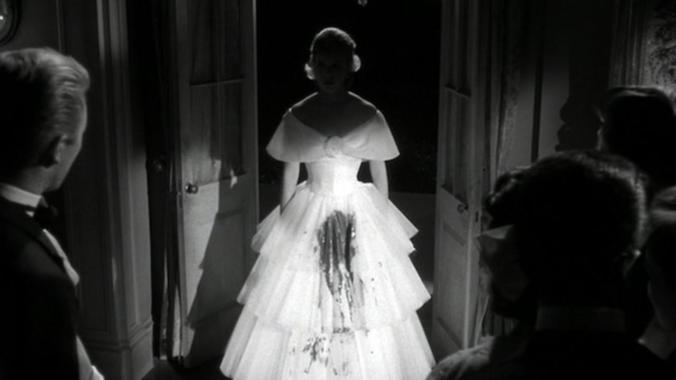
Our next Halloween review is dedicated to Pre-Code Hollywood: that magical time between the birth of sound and the dawn of strict censorship when gangster movies could be harsher, romantic comedies saucier, and horror movies more perverse. It is from this era, and this era alone, that you can stumble across as invigoratingly weird as 1932’s Island of Lost Souls.

It is, in so many ways, an authentic trashterpiece: a quickie adaptation of H.G Wells’ The Island of Dr. Moreau, barely over an hour long and directed by a certifiable non-auteur (studio man Erle C. Kenton), whose main attractions are Charles Laughton with a whip, Bela Lugosi in a furry mask, and a slinky actress listed in the opening credits only as “The Panther Woman.” (Historical scholarship tells us that the Panther Woman was a 19-year-old dental assistant from Chicago who won a contest to appear in a Paramount Picture. Hooray for Hollywood).

And yet the appeal of the film, aside from that utter weirdness, is how it finds that B-movie paradise between the tawdry and the serious. There are real technical accomplishments in the film, from the makeup to the cinematography by Karl Struss, who had been behind the camera for more respectable movies, like F.W. Murnau’s classic Sunrise (1927). And even as it qualifies as primo vintage camp, there’s a subversively playful bite to its allegory as well. Moreau describes himself as “god”, and has made it his project to rid, train, condition, and surgically remove all bestial instincts from animals. Yet suppose this doctor or this god is a fraud, and that animals (and men) prefer to be beasts?

I imagine that this high-minded subtext comes from the H.G. Wells novel, and the rest comes from an early-1930s studio system that didn’t know any better. Enjoy it as such, but don’t dare call it “so bad it’s good”; there are some truly potent moments that no studio man would be able to get away with a few years later. The film’s last few seconds, where a genuinely disturbing horror movie finale suddenly gives way to the inappropriately cheerful, please-exit-the-theater end credits music, never fails to make me smile at what the industrial system of Old Hollywood was capable of.

✬✬✬✬✩

********

Halloween Countdown is an annual, personal, and highly unoriginal tradition where I write fast, extemporaneous reviews of 20 prominent but random horror movies during the month of October.


Short Cuts: LUCKY

lucky

“Harry Dean Stanton is…,” the opening credits of Lucky say in big letters right before the title, thus conferring upon one of our humblest players a level of movie-carrying star power usually reserved for a Schwarzenneger or a Stallone. When Harry Dean Stanton passed away last month at the age of 91, he had stayed active until the end. Very few movies gave him the leading role; the only ones I can think of off the top of my head are Repo Man and Paris, Texas, both from thirty years ago. But the outpouring of grief from cinephiles was rightly that of an icon, one who delivered more fine performances for more fine directors than we could keep track of, and I suspect this is also because those performances always felt more open than transformative. That is, unlike an Oscar titan like Meryl Streep or Robert De Niro, you got the sense (illusory or not) that if you were fortunate enough to meet him in person, he would probably be pretty close to what you knew from his best roles, with little pretense of celebrity. So Harry Dean Stanton is Lucky, and Lucky is an old soul in an older body, a chain-smoking retiree whose tranquil routine—maybe too tranquil, for some audience members—is broken when it starts to sink in that he can’t go on forever.

In a way, it’s amazing that this film—directed by the actor John Carroll Lynch (who has a pretty wide resumé of supporting roles himself)—gets away with as many contradictions as it does. It stays remarkably light and buoyant for a film that keeps pondering mortality, subjectivity, and “the void”, and then throws in a metaphorical Garden of Eden just for good measure. And it maintains grave seriousness even as its view of a small town in the American southwest is atilt with comic eccentricity. (Cinephiles will get the bonus of watching a well-cast David Lynch play a man uncommonly obsessed with his tortoise). Undoubtedly, this is because the film avoids the easiest climactic ways out—Lucky has, for instance, no estranged family member he needs to reconcile with—while allowing its little details and discrete vignettes to mean as much as its “big scenes.” I suspect the movie is perfectly satisfied to be small, and to see what it can find within that scale. There’s a scene at the end when Stanton, who by the then has been at both the giving and receiving end of fine monologs, suddenly makes eye contact with the camera and lets out a big silent grin—and for a second, you can’t tell if you’re looking at the character or the actor himself. Lucky is, by design, a film too miniature and too shaggy for entry into Valhalla. But that moment is one of the most subtly transcendent shots I’ve seen this year; it left me both heartbroken and exiting the theater on a high. As the movie keeps reminding us, everyone will die someday. But not every actor gets to take such a lovely final bow.

✬✬✬✬✩

********

Lucky is still playing in a few theaters. See it with a small crowd of people who care.

Halloween Countdown: IN THE MOUTH OF MADNESS

in-the-mouth-of-madness

Here’s a question that can get movie buffs arguing: did John Carpenter make a truly good film after 1990? It’s a question with added relevance when the return of Stranger Things—which is part homage to Carpenter—is building hype. From the mid-70s to the late-80s, he made his mark as a unique voice in American genre cinema: The Thing (1982) and Halloween (1978), certainly, but I count a solid half dozen other cult gems of action, sci-fi, and horror with varying degrees of “classic” status.

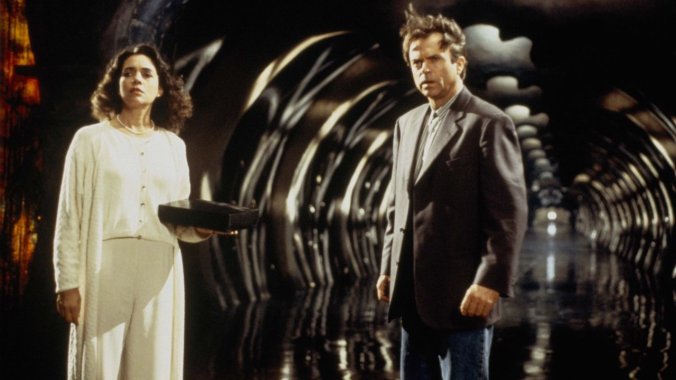
Then the 90s came, and he started to look like a director whose context had disappeared. This is not to say there weren’t fine moments to come—if you catch me with my guard down, I’ll even have pleasant things to say about Ghosts of Mars (2001). But the latter-day film a Carpenter buff is most likely to make big claims for is this 1994 horror show: In the Mouth of Madness. The good people at the prestigious Cahiers du Cinema, suckers for genre films with meta-subtext that they are, even voted it one of the best films of the year. It follows Sam Neill as an insurance investigator looking into the disappearance of a pulp horror writer—Stephen King as H.P. Lovecraft may have imagined him—whose writing is starting to break out of its fictional confines and effect the real world. Carpenter thought of this film as the finale to his thematic “Apocalypse Trilogy”, started by The Thing and continued with the underrated Prince of Darkness (1987).

You have to care more about horror paperbacks than I do to see this all as a canny prophesy instead of an idle game. But In the Mouth of Madness does have a very intriguing idea on its side: that a well constructed work of fiction can override your reality, even when you know it’s fake. And thus the best moments of the film come when it scares you (sometimes exquisitely) while making as little sense as possible. It works as well as it does by sticking with the spirit of Lovecraft’s short stories, in which a hero tries to rationally narrate his own story while clearly going off the deep end. And per Carpenter’s standards, it leads to a bonkers final scene that reminds me of what we always loved about him: that his genre films were very un-generic.

The scariest thing may be that 1994 FX now look like they’re entering the realm of camp. I was around in ’94, and it didn’t look that way at the time. An ill omen for the future, if there ever was one.

✬✬✬✩✩

*********

Halloween Countdown is an annual, personal, and highly unoriginal tradition where I write fast, extemporaneous reviews of 20 prominent but random horror movies during the month of October.

Halloween Countdown: THE INNOCENTS

the-innocents

Nothing ages worse than horror, they say. And they’re not wrong. So when I popped in a copy of The Innocents a while back, knowing absolutely nothing about it, I was expecting a fairly low-key evening. After all, gothic horror is by definition old-fashioned, and how scary could a haunted house movie made in 1961 be?

Two highly disconcerting hours later, it turns out that the type of horror movies that age are the ones that revolve around a very contemporary type of shock. But aim for the subconscious, and you get something timeless. All you really need are lights, shadows, the right pacing, a good actor’s face, a subtext that corkscrews its way into your mind, and a director—like the estimable Jack Clayton—who knows how to use them. The Innocents has all of these in spades: its total death toll is one, and I suspect it will continue to be scary long after our jaded, bratty grandchildren find Eli Roth torture porn boring and tame.

The plot is about a repressed governess sent to a remote manor to look after two small children. Only, as isolation sets in, she begins to suspect the children are possessed by some horrifying evil force. The atmosphere is exquisitely frightening and irrational, full of weird choices, like casting the 40-year-old Deborah Kerr as a sexually repressed 20-year-old, that make you question your sanity. It’s enduring triumph is asking if ghosts exist only in mind—and that if they do, maybe that alone is enough for a haunting.

✬✬✬✬✬

********

Halloween Countdown is an annual, personal, and highly unoriginal tradition where I write fast, extemporaneous reviews of 20 prominent but random horror movies during the month of October.
Short Cuts: A GHOST STORY

a-ghost-story

I’ve never believed in ghosts, but movies may be the next best thing: apparitions of light and shadow taking the form of a person or a moment whose original no longer exists. At the movies, the dividing line between one mortal plane and the next can be as simple as a cut, a fade, or a presence implied where none is seen. And for this reason, some of the most effectively ghostly special effects predate not only the digital revolution, and not only color film stock, but sound cinema itself. So credit David Lowery for creating an appropriately elemental spirit and a proudly analog look—even as a digital rental—with A Ghost Story. A nameless man and wife (Casey Affleck and Rooney Mara) live together until he dies in a tragic accident. From there, looking like a man under a sheet with holes cut out for eyes, his ghost haunts their old house and watches both mournfully and angrily as time moves on without him.

It is not the easiest film to get into, just like any film that treats its actors more as photographic models than characters. And as it rockets off into the mysteries of space and time, the true fullness of its cosmic aspiration is beyond the film’s reach. Its level of insight is no more profound, or less obvious, than the philosophical rap about tiny human footprints in an infinite universe that a guest (Sundance stalwart Will Oldham) delivers at a shindig after the house has been invaded by post-grads. In other words, A Ghost Story is not so much the wisdom of a life lived as it is dinner party conversation for intellects of a certain age. But it is also a work of cinematic imagination from an up-and-comer who wants to build on the very Malick-isms that have turned so many moviegoers off. The middle passage, where time slips between cuts and pans, is beautifully detailed. The authentically muted portrayal of Rooney Mara’s grief, done with a minimum of dialogue or actorly emoting, has stuck with me. Even the moments where it risks silliness—and doesn’t always come away clean—have a lucid audacity to them. It’s certainly not horror, but it is empathetic to why you would want to haunt a world where everything keeps sliding away. That emotional core works, and any sad sack could tell you it means as much for the living as it does for the dead.

✬✬✬✬✩

********

A Ghost Story is available to rent on iTunes. This Halloween, try fun-sized pretension.

Halloween Countdown: HUSH… HUSH, SWEET CHARLOTTE

sweet-charlotte

As American cinema entered the 1960s, a curious trend arose of big stars from the past getting cast in camp horror movies, as though Old Hollywood itself were by then something of a haunted house. And thus, with 1964’s Hush… Hush, Sweet Charlotte, came the delicious idea to take Bette Davis (from Jezebel (1938)) and Olivia de Havilland (from Gone with the Wind (1939)) and cast them as two ex-debutante hellcats duking it out in a crumbling Southern mansion full of terrors. The director was the great Robert Aldrich, and he had been in this territory before, with the similarly morbid battle of wits—who can be trusted? who is insane?—in What Ever Happened to Baby Jane? (1962). Sweet Charlotte is something of Baby Jane‘s homicidally jealous younger sister, a B-side mystery with meat cleavers, severed hands, and poor Bruce Dern meeting a sorry fate.

To that, you can throw in Joseph Cotten, doing an uncharacteristically hammy performance the way a pro pitcher might let his son win at tee-ball, and you have the new kind of self-conscious cult cinema that was capturing the imagination. At 133 minutes, it’s a bit long and convoluted for this sort of thing. But Aldrich exercises wonderful control over the stormy set-pieces and the ghoulish sense of humor, and the film’s head isn’t empty. It’s a game of movie star personas about the perils of being (in)famous, elevated because such talents would stoop to the material. And its narrative trap snaps shut with the glorious payoff of Bette Davis doing a demented version of walking the red carpet. I’ll take it over Scarlet O’Hara any day.

✬✬✬✬✩

********

Halloween Countdown is an annual, personal, and highly unoriginal tradition where I write fast, extemporaneous reviews of 20 prominent but random horror movies during the month of October.

Halloween Countdown: THE OMEN

the-omen

His name is Damien. He has a dead-eyed stare, a strange birthmark, an indifference to the pain of others, and—raised unwittingly by a morally upright Gregory Peck—he has been sent here by Satan and 20th Century Fox to create a new franchise. He was not horror cinema’s first creepy child, and certainly wouldn’t be its last. But after The Omen opened in 1976, he became arguably its most iconic.

In truth, The Omen today is a film that’s more “iconic” than “great,” pulling textures and elements from Don’t Look Now (1973), The Exorcist (1973), and Rosemary’s Baby (1968) and making them a bit more pop, a bit more kitsch, and a bit more safe—if you show it at a movie night, there’s less of a chance you’ll deeply unsettle any of your friends than if you have the hubris to pick something that’s “out there.” But the virtues of the film shouldn’t be ignored. Gregory Peck brings gravitas wherever he goes, and it gives the script a touch more prestige than it deserves. The sound design is creepy. The gothic imagery shows how a good color scheme goes a long way. And Jerry Goldsmith got a song called “Ave Satani” nominated for an Academy Award (I sincerely hope it was performed during the ceremony, to turn the Oscars into the dark ritual they always kind of are).

The Omen‘s biggest drawback today is that it feels light; its strongest impression is that, eight years and six Black Sabbath albums after Rosemary’s Baby, fictionally giving birth to the Antichrist had gone from a queasy metaphor to a fun hobby. So I wish it did more with the themes it touches on but leaves largely unexplored: the psychodrama of being locked in a battle with your own offspring, and the sneaking suspicion that 1976 looked pretty close to Armageddon already.

✬✬✬✩✩

*********

Halloween Countdown is an annual, personal, and highly unoriginal tradition where I write fast, extemporaneous reviews of 20 prominent but random horror movies during the month of October.

Short Cuts: WIND RIVER

Wind River - Still 4

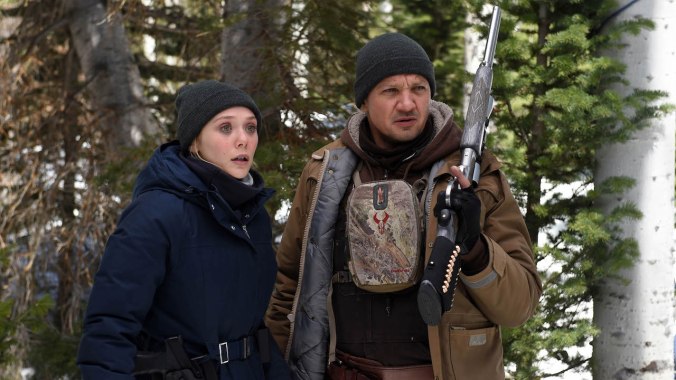
When filmmaker Taylor Sheridan was last in theaters, it was as the writer (but not director) of last year’s Oscar-nominated Hell or High Water. I didn’t shine to that film as much as some of my friends or the Academy; it was a solid western noir script, but the presentation of it felt too glossy by half. That is, for its tale of crime and punishment in the American heartland, I could never quite shake the feeling that I was watching movie stars play-acting for a camera. Wind River, his follow-up and his first time directing his own script, takes its atmosphere a step in the right direction simply by being more stark. It feels brought down to the soil, even if the soil is under three feet of snow.

Old Hollywood has its own tradition of borderland noir—Touch of Evil (1958), Ride the Pink Horse (1947), etc.—and Wind River aspires to work a twist on that fear of lawlessness by being set on America’s border with itself. Or to be more specific, an Indian reservation, with all the federal neglect that entails, where Native Americans mingle with the white inhabitants of a nearby Wyoming town, and where a local hunter (Jeremy Renner) and a green FBI agent (Elizabeth Olsen) have to solve the murder of a Native American teen, found dead in the snow miles from the nearest anything. The murder mystery itself is completely linear, but I’d wager that’s not a poverty of imagination so much as a sad-eyed interest in inevitability. Sheridan remains a fine observer of the heartland, with a good ear for dialogue, an ability to add personal nuances to characters who might otherwise fade into cliche, and a strong sense for a version of American life that’s a million miles away from the Westwood Village, where I saw the film.

There is, I think, a certain obviousness that mars the film: an obvious mystery, an obvious rape-revenge resolution, and an obvious cinematic style, limited to a few mood-setting chords and anonymous handheld photography. Sheridan has room to grow as a filmmaker, but he knows how to keep a plot clipping along, when to drop the thematic hammer, and how details can turn a corpse into more than a mere procedural. Wind River‘s interest is in different kinds of American society, where new generations make their stand on top of old legacies, and where the past should neither determine fate nor be forgotten. And on those counts, Wind River lands some inspired touches and fine climactic monologues. Its overt social conscience toward modern Native American life is undercut, or at least complicated, by the fact that the hero relied on to mete out justice is a white man, treated cinematically as a kind of cowboy and Indian rolled into one. But in one of the keener details, we see that his Native American ex-wife is raising their mixed race son on a track of upward mobility, pointed towards bigger towns with better pay and better schools. And I like to imagine they’ll be moving on while he’s content to stay. Like any good revenge story, it seems mournfully hesitant at the idea that the present can ever truly set the past right. But it’s smart enough to keep one eye cagily trained on the future.

✬✬✬✬✩

********

Wind River is still haunting a few second-run theaters. You can download it legally by the end of the month.

Halloween Countdown: THE WICKER MAN

wicker-man

Last year, I started a personal Halloween tradition of posting reviews of 20 horror movies on my Facebook. The idea was to write them short, fast, and colloquial, no proof-reading allowed, and only for an audience of friends—which, at the time, was more fun and only slightly less lucrative than being a freelance film writer in Brooklyn. This year, I port the tradition over to my blog, and to kick off the Halloween bash in the name of weird costumes, cult rituals, pop paganism, and director Robin Hardy, who passed away last year, we turn our morbid gaze to his original 1973 The Wicker Man.

Among American millennials, The Wicker Man may be best known for a quite awful Nicolas Cage remake that got distilled into a quite hilarious, context-free viral YouTube highlights reel. But the original has an imposing reputation for genre fans. First released alongside Nicolas Roeg’s Don’t Look Now in the double bill of every British paranoiac’s dreams, The Wicker Man has been poured over, acclaimed, restored, and recreated as a Radiohead music video. But the mystery still maintains a spooky intrigue of its own, even if it doesn’t quite live up to its rep.

On a remote Scottish island sinister enough that Christopher Lee is in charge, and kinky enough that Britt Ekland is always up for whatever, a devout Christian police inspector arrives to investigate the report of a missing young girl. It soon becomes apparent that a conspiracy is afoot, and that the old druidic ways of superstition and godless sex have taken over this isolated community. Our Hero comports himself with a certain lack of awareness, slow to catch on to just how much danger he’s really in. Is it sloppy writing, or is it just that Our Hero stubbornly believes enough in Jesus Christ and Her Majesty the Queen to assume no one would dare touch him? Either way, as it death-marches to its finale, The Wicker Man is less an airtight mystery thriller than a kind of religious parable for happy nihilists.

It’s also a masterclass in threatening coziness, in the ways that the ruddy, friendly faces of a rural town can creep you the hell out. (A lesson that Edgar Wright, one of the film’s on-the-record cultists, surely picked up on for Hot Fuzz). In many ways, remaking it in the 21st century seems like a sketchy idea to begin with, not just for all the obvious reasons, but because The Wicker Man is so much rooted in its time and place: the post-counterculture hangover of the early 70s. The central conflict is essentially a battle between a conservative establishment and a libertine commune that makes up rules of its own, and the film’s sneakiest coup is that both ways of living your life come across as utterly unappealing. So take the ride, because it has a prime horror movie ending. And if that prime horror movie ending bums you out, you can always pick yourself up again by heading to YouTube and watching Nicolas Cage scream about the bees.

✬✬✬✬✩

********

Halloween Countdown is an annual, personal, and highly unoriginal tradition where I write fast, extemporaneous reviews of 20 prominent but random horror movies during the month of October.
Short Cuts: IT COMES AT NIGHT

it-comes-at-night

It Comes at Night first came to my attention over the summer, when a writer for the Guardian coined (or tried to coin) the term “post-horror”, to describe not only It Comes at Night, but other recent releases like Personal Shopper and A Ghost Story. Here were films that borrowed iconography and plot elements from the horror genre—and maybe even had a scare or two—but whose pacing and focus on cosmic, spiritual, or existential concerns made them more at home in an arthouse or on the festival circuit than in Netflix’s Horror carousel. Once the term “post-horror” hit the hivemind of the internet, a lot of genre fans rightly called bullshit, and they have two good reasons for doing so. First, because the term implies that there’s something about the genre that needed a high-minded corrective—”isn’t it about time?” said the Guardian—when directors like Brian De Palma and George Romero were able to put provocative subtext or sophisticated craft into packages a hell of a lot schlockier than any of the movies listed above. And second, because the traits of a “post-horror” film (an emphasis on poetic visuals, dreamy pacing, and cosmic/spiritual/existential concerns over conventional frights) aren’t really new to the genre at all, a small cluster of them in a few months notwithstanding.

But if there’s one value of the term “post-horror” trying to be forced into existence, it’s in how it draws attention to the way such films are marketed, and to the gap between critics’ and audiences’ perception of them. To the extent that any film’s reception can be numerically quantified—and isn’t that what the internet keeps trying to do with everything?—there’s no doubt that there seems to be a gap between “the critics” (RottenTomatoes) and “the people” (IMDb, CinemaScore, etc.) when it comes to It Comes at Night. As for whether it’s the movie’s fault, or just that weekend audiences who pay to see a horror flick want something less cryptic and more viscerally immediate, I think in this case they can split the difference.

So how is the film? Pretty good, so let it never be said an enterprising filmmaker can’t end the world on a tiny budget. Set in a world where a plague has wiped out most of human civilization, an interracial family tries to scrape by in their house in the woods. The son is troubled by nightmares, the (white) father protects them with a cold, tribal pragmatism. When they agree to let in another, much more more noticeably happy family, the tense truce that ensues builds to a bloody climax. For most of its runtime, it’s a mood piece, trying to make a cramped wooden house as atmospheric and unpredictable as the Overlook Hotel, with varying results. Frustration can be understandable, since the film’s sparse scene-by-scene storytelling suffers from a certain vagueness: a vague post-apocalyptic scenario and a vague “it” stalking the woods yield a vague allegory—something about American isolation, something about paranoia, maybe something about race—that, like many films from the indie sphere, feels like a strong concept that had to be padded to reach 90 minutes. It is only in the third act that the vagueness starts to lift, at least thematically, leading to a terrific payoff for anyone who doesn’t insist that stories be tidy. The biggest mystery is an open chasm, but there’s something rewarding about its core: a traumatized young boy whose dream sequences have a hint of prophesy, but who is ultimately unable to change the direction of the narrative at all. It’s enough to mark writer-director Trey Edward Shults as a talent to watch: a filmmaker with ideas awaiting a more robust treatment. Here’s rooting for him.

✬✬✬✩✩

*********

It Comes at Night is available to rent on iTunes. Beware of red doors.