Halloween Countdown: DON’T LOOK NOW

dont-look-now

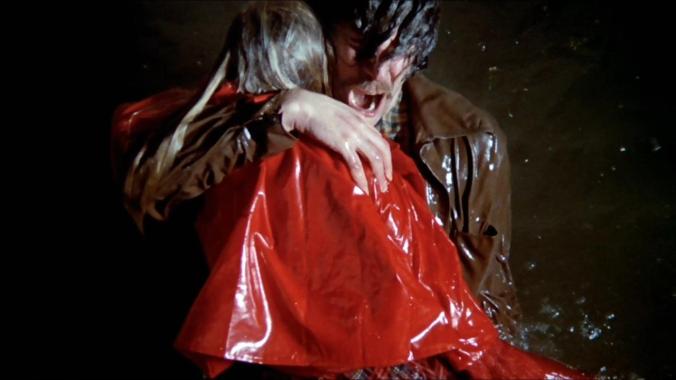
There’s a fine moment near the center of Nicolas Roeg’s Don’t Look Now (1973) where a police inspector looks Donald Sutherland in the eye and says, in a voice dripping with dark possibility, “What are you fearing, Mr. Baxter?” It’s a provocative question for the film. Normally in a horror movie, we know what’s out to get us: slashers, ghosts, the living dead, the birds, the fog, etc. But who or what is the villain in Don’t Look Now? There is one, I suppose, and I wouldn’t dream of spoiling the infamous scare that comes at the end. But the overriding mood of Don’t Look Now is one of exquisitely evocative paranoia: a trap where we feel that some unknown conspiracy of some unknown purpose is afoot, and every bit player—even the hotel chambermaid, even the police inspector himself—seems like they’re in on it.

And so, from the Golden Age of Paranoia (the 1970s) comes a film whose very irrationality elevates it above its brethren: for once, we can’t so easily tell where it’s going. I can’t help but think of how fitting it is that it came out at almost the precise midpoint between Alfred Hitchcock’s last masterpiece and David Lynch’s first. The Hitchcock link is more than spiritual; the story derives from Daphne Du Maurier, who provided the source material for The Birds (1963) and Rebecca (1940). Thus we open when a couple (Sutherland and Julie Christie) lose their daughter in a terrible accident. And, then, some years later, on a trip to Venice, they begin to think they see her…

The plot that unfolds puts us in the realm of schlock and pulp, with murderers and clairvoyants wandering about. But Roeg—formerly a cinematographer, and it shows—exercises a rigorous control over the visuals, carrying it into the realm of dreams. I know viewers who find it slow, who chafe at the dialogue-free stretches and absence of chances to laugh, which means that it’s become the kind of “director’s movie” treasured by cinephiles and formalists above all else. But I couldn’t go without its way of spooking you. Tense and ambiguous to the end, it hits the sweet spot where it leaves just enough said and unsaid to be both lucid, coherent, and aimed directly at the subconscious.

✬✬✬✬✬

********

Halloween Countdown is an annual, personal, and highly unoriginal tradition where I write fast, extemporaneous reviews of 20 prominent but random horror movies during the month of October.
Halloween Countdown: THE DEVIL’S BACKBONE

devils-backbone

Supposedly, during the production of The Shining (1980), Stanley Kubrick once called Stephen King and asked him, “Don’t you think ghost stories are inherently optimistic, because it means we continue to exist after we die?” King sounded unsure. But something of that essential optimism is very much at work in the first few films of Guillermo del Toro.

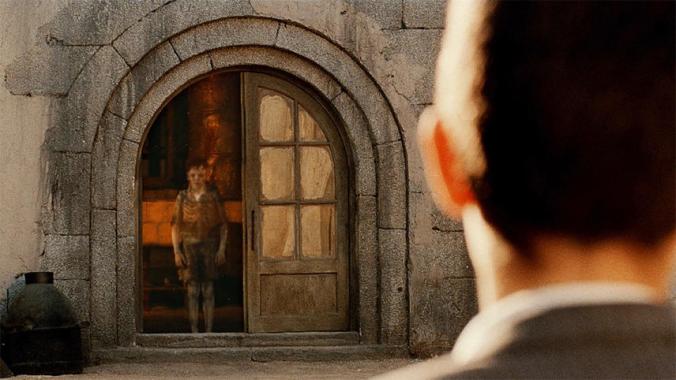
Del Toro is at home in the world of monsters—a walking encyclopedia of filmdom’s strange abominations, and a true acolyte of the idea that “the creature” could be the misunderstood hero of every movie it’s in. His reputation (a “visionary”, said the trailer for Crimson Peak (2015)) got knocked to the IMDb stratosphere by Pan’s Labyrinth (2006), the rare pop masterpiece that felt equally at home at the Cannes Film Festival, the Oscar stage, and Comic-Con. The Devil’s Backbone (2001) is its predecessor: a young boy gets sent to an orphanage during the Spanish Civil War, where adult trouble brews while a ghostly child wanders the halls.

It is, more or less, a straightforward ghost story, done with del Toro’s visual sense for quasi-surreal proportions and super-saturated colors. Almost nothing in the narrative should scare or surprise you. But on the way home, you might find yourself thinking about how richly del Toro layered his characters, how much he feels for them, and how much the movie is about the hope that there’s something more lasting to human life than just what’s physical. In its own morbid, bittersweet way, it is an optimistic film. Perhaps because, when del Toro shows you a ghost at night, he doesn’t want you to jump. He wants you to find it beautiful.

Fingers crossed that this year’s The Shape of Water can keep up with the hype.

✬✬✬✬✩

********

Halloween Countdown is an annual, personal, and highly unoriginal tradition where I write fast, extemporaneous reviews of 20 prominent but random horror movies during the month of October.
Halloween Countdown: ERASERHEAD

eraserhead

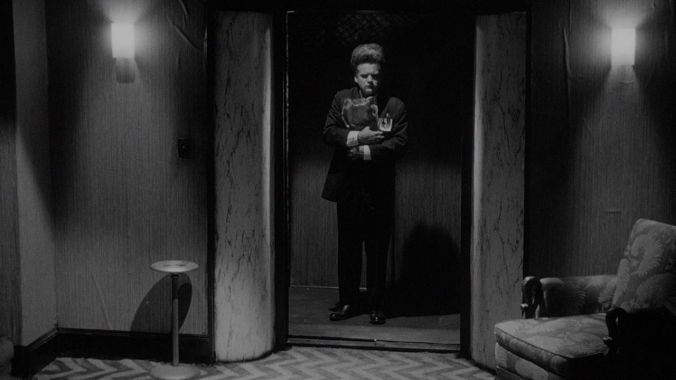
There’s an art to picking a movie for a Halloween movie night: it should be scary but not disturbing, it should have laughs, it should play well in a social setting, and it should leave people pleasantly spooked and not, ya know, traumatized. In other words, no matter how often your friend Lauren feels the need to look away, it should create more smiles than provocation. So here’s one you should definitely not use—unless you have a rarified group of friends, in which case, power to you: David Lynch’s 1977 debut Eraserhead.

Lynch’s place in “horror cinema” is a debate about genres I find fascinating. On one hand, films of his that sometimes get tagged with the label—like Lost Highway (1997) and Mulholland Drive (2001)—have almost none of the plot tropes we commonly associate with horror. But on the other hand, they’re really fucking scary, and just as a comedy is supposed to make you laugh, isn’t that the point? Eraserhead, essentially the most famous student film ever made, is a repulsive feature-length nightmare, and it owes its midnight-hit reputation to downtown hipsters who dared each other to see it.

For the newcomers, the tune goes something likes this. In a toxic industrial city, a timid young man’s girlfriend gives premature birth to a mutant baby and then runs off, leaving him to care for the thing. As the baby laughs, mewls, and rots, the young man grapples with sordid attraction for his next door neighbor, has a nightmare in which his head is cracked open and his brains are used to make erasers, and daydreams about crawling inside his apartment radiator where a woman with swollen cheeks assures him that “in Heaven, everything is fine”.

In short, it’s a film that’s almost impossible to spoil. You could describe Eraserhead shot for shot to someone, and then when they sit down to watch it, the irrational terror would be undiminished: Lynch is a master of ideas that don’t “make sense” but somehow strike directly into the subconscious. That much I expected the first time I watched it. But what’s even more surprising, for such a low-budget production, is the film’s utter control of technique, the perfect completeness of its imaginary universe, the moments of bizarre humor, and the way that even though its setting is through the looking glass, it feels uniquely American.

Just tread carefully. Its imagery will be superimposed over everything you look at for at least a day or two.

✬✬✬✬✬

********

Halloween Countdown is an annual, personal, and highly unoriginal tradition where I write fast, extemporaneous reviews of 20 prominent but random horror movies during the month of October.

Halloween Countdown: ROSEMARY’S BABY

rosemarys-baby

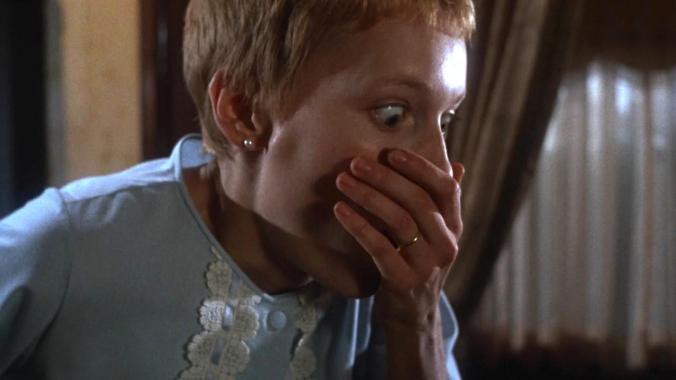
I won’t forget the sudden chill I felt when Mia Farrow sees her baby and recoils. It is one of the great moments in the horror canon, a testament to the power of the human face  in cinema. We never see the baby ourselves—nor should we—but her bulging eyes belong to the history.

So Rosemary’s Baby (1968) is one of my favorite horror movies, and probably one of yours, too, though it now seems much closer to 60s/70s paranoia thrillers than it does to today’s horror flicks. This also means Rosemary’s Baby faces the obstacle that all paranoia thrillers face: namely, we figure out what’s going on long before the hero(ine), and then have to wait for them to catch up. But that’s just the raw framework, and Rosemary’s Baby hangs on it a richly detailed story about a mild-mannered woman struggling for a voice when surrounded by people who want to use her.

Despite having two bona fide horror classics to his name, Roman Polanski wasn’t mainly a horror director, or necessarily a thriller director either. His recurring M.O. is trapping opposing/incompatible forces together in close quarters, and then having them fight for dominance. Over the years, this method lent itself to melodrama or dark, absurdist comedy as much as paranoid conspiracy.

Rosemary’s Baby has pretty much all of the above, so don’t miss how much weird humor it packs in, including having its villains be two senior citizens whose enthusiastic kindness and vulgar wardrobe only make them more sinister. Its great horror coups are turning pregnancy into the original “body horror” and turning a single apartment—home, where you should be safe—into a fresh minefield for claustrophobic fear.

The ending will continue to cause debates, I’m sure, and I’ve encountered more than one person who feels it doesn’t add up. But the horror that lingers after the film (as opposed to the very modest number of horrors in it) is the idea that agency might be snuffed out, and that accepting your role might be a fact of life.

Let your eyes widen.

✬✬✬✬✬

********

Halloween Countdown is an annual, personal, and highly unoriginal tradition where I write fast, extemporaneous reviews of 20 prominent but random horror movies during the month of October.

Halloween Countdown: GREMLINS

gremlins

The appreciation of Gremlins (1984) director Joe Dante as a proper film artist is nothing new—Jonathan Rosenbaum, for one, has been arguing it for decades. But I do wish it were more widespread.

Gremlins, coming in the era of the “high concept” FX blockbuster, is easy enough to pitch. Just say “It’s a Wonderful Life meets The Blob“, or “it’s E.T. but evil”, and you’re in a kind of alchemical genre paradise: a mixture of Roger Corman, Steven Spielberg, Looney Tunes, and 50s monster movies, as Dante gathers as much mid-century American kitsch as he can get his hands on just so he can have fun blowing it all up. Not that the town these critters arrive in isn’t in dire need of some chaos. You know the rules, and to break them: don’t get them wet, keep them out of sunlight, and never ever feed them after midnight

The explicit references to E.T. (1982)—Spielberg was on hand as producer—are a joke the entire world is in on, but they also put Dante’s and Spielberg’s presentations of childhood in delightful and provocative contrast. It is as if the film is a riposte to all that’s tender in the Spielberg universe, arguing that for every sweet child who badly wants an imaginary friend and a complete family, there’s a half-dozen pint-sized anarchists who daydream about kicking over their school like it was made out of LEGOs. (Echoing similar remarks made by Roald Dahl and Terry Gilliam, Dante noted that the grislier moments of this “kid’s film” horrified the parents more than the children).

And so we have a horror movie for innocent kids, best appreciated when they become warped adults. Some of you may argue that the film is better for Christmas than for Halloween. The two holidays can take turns holding it, as far as I’m concerned. Come November 1st, the discounted candy and the Santa hats will be sold in the same aisle.

✬✬✬✬✩

********

Halloween Countdown is an annual, personal, and highly unoriginal tradition where I write fast, extemporaneous reviews of 20 prominent but random horror movies during the month of October.

Halloween Countdown: DRACULA

Dracula1931.jpg

As I write these, a friend of mine posed a challenge: to review a film I don’t like. Here, I face a choice. “Bad horror films” is a hole with no bottom. Most of the ones I’ve stumbled into by circumstance have already been forgotten—remember 2008’s The Strangers, with Liv Tyler? anyone?—and there’s no point resurrecting one of the many formula hack-jobs just to bury it again. So instead I picked a legitimate classic that I legitimately think is a bad movie: the famous 1931 Dracula, starring Bela Lugosi.

This has little to do with age. There are movies just as old—and older—that retain mystery and fear. But Dracula commits one of the worst sins of movies: most of it is shockingly un-cinematic. A lot of this has to do with its origin: for legal reasons, the original novel couldn’t be licensed, so the studio licensed a later Dracula stage play instead, one tethered to some of the worst conventions of early 20th century theater. The director, the talented Tod Browning, reportedly didn’t have his heart in it, leaving his DP to take over for much of the shoot. So, despite some strong, atmospheric art direction near the beginning, the result is largely a lot of silly characters standing around saying silly things. Vampyr, from 1932, showed the dark lyricism that could be found if such material were treated with high-minded artistic ambition. On the opposite end of the spectrum, Island of Lost Souls (also 1932) showed the subversive, transgressive thrills possible when pulp material lets its id get out.

By comparison, Dracula is a lifeless pageant. But it was a huge success at the time, then segued into classic status borne on nostalgia, even though it’s a poor representative of what filmmakers in the early 1930s could do. (This, in itself, is a pernicious trend of how our canons are formed and remembered). So by all means see it, check it off your list, hum along to its clever and legally expedient appropriation of “Swan Lake”, and enjoy the iconic moments it has to offer. But don’t walk out thinking “boy, we’ve come a long way.” Even when Dracula was new, we already had.

✬✬✩✩✩

********

Halloween Countdown is an annual, personal, and highly unoriginal tradition where I write fast, extemporaneous reviews of 20 prominent but random horror movies during the month of October.

Halloween Countdown: ISLAND OF LOST SOULS

Island-of-Lost-Souls

Our next Halloween review is dedicated to Pre-Code Hollywood: that magical time between the birth of sound and the dawn of strict censorship when gangster movies could be harsher, romantic comedies saucier, and horror movies more perverse. It is from this era, and this era alone, that you can stumble across as invigoratingly weird as 1932’s Island of Lost Souls.

It is, in so many ways, an authentic trashterpiece: a quickie adaptation of H.G Wells’ The Island of Dr. Moreau, barely over an hour long and directed by a certifiable non-auteur (studio man Erle C. Kenton), whose main attractions are Charles Laughton with a whip, Bela Lugosi in a furry mask, and a slinky actress listed in the opening credits only as “The Panther Woman.” (Historical scholarship tells us that the Panther Woman was a 19-year-old dental assistant from Chicago who won a contest to appear in a Paramount Picture. Hooray for Hollywood).

And yet the appeal of the film, aside from that utter weirdness, is how it finds that B-movie paradise between the tawdry and the serious. There are real technical accomplishments in the film, from the makeup to the cinematography by Karl Struss, who had been behind the camera for more respectable movies, like F.W. Murnau’s classic Sunrise (1927). And even as it qualifies as primo vintage camp, there’s a subversively playful bite to its allegory as well. Moreau describes himself as “god”, and has made it his project to rid, train, condition, and surgically remove all bestial instincts from animals. Yet suppose this doctor or this god is a fraud, and that animals (and men) prefer to be beasts?

I imagine that this high-minded subtext comes from the H.G. Wells novel, and the rest comes from an early-1930s studio system that didn’t know any better. Enjoy it as such, but don’t dare call it “so bad it’s good”; there are some truly potent moments that no studio man would be able to get away with a few years later. The film’s last few seconds, where a genuinely disturbing horror movie finale suddenly gives way to the inappropriately cheerful, please-exit-the-theater end credits music, never fails to make me smile at what the industrial system of Old Hollywood was capable of.

✬✬✬✬✩

********

Halloween Countdown is an annual, personal, and highly unoriginal tradition where I write fast, extemporaneous reviews of 20 prominent but random horror movies during the month of October.
 

Short Cuts: LUCKY

lucky

“Harry Dean Stanton is…,” the opening credits of Lucky say in big letters right before the title, thus conferring upon one of our humblest players a level of movie-carrying star power usually reserved for a Schwarzenneger or a Stallone. When Harry Dean Stanton passed away last month at the age of 91, he had stayed active until the end. Very few movies gave him the leading role; the only ones I can think of off the top of my head are Repo Man and Paris, Texas, both from thirty years ago. But the outpouring of grief from cinephiles was rightly that of an icon, one who delivered more fine performances for more fine directors than we could keep track of, and I suspect this is also because those performances always felt more open than transformative. That is, unlike an Oscar titan like Meryl Streep or Robert De Niro, you got the sense (illusory or not) that if you were fortunate enough to meet him in person, he would probably be pretty close to what you knew from his best roles, with little pretense of celebrity. So Harry Dean Stanton is Lucky, and Lucky is an old soul in an older body, a chain-smoking retiree whose tranquil routine—maybe too tranquil, for some audience members—is broken when it starts to sink in that he can’t go on forever.

In a way, it’s amazing that this film—directed by the actor John Carroll Lynch (who has a pretty wide resumé of supporting roles himself)—gets away with as many contradictions as it does. It stays remarkably light and buoyant for a film that keeps pondering mortality, subjectivity, and “the void”, and then throws in a metaphorical Garden of Eden just for good measure. And it maintains grave seriousness even as its view of a small town in the American southwest is atilt with comic eccentricity. (Cinephiles will get the bonus of watching a well-cast David Lynch play a man uncommonly obsessed with his tortoise). Undoubtedly, this is because the film avoids the easiest climactic ways out—Lucky has, for instance, no estranged family member he needs to reconcile with—while allowing its little details and discrete vignettes to mean as much as its “big scenes.” I suspect the movie is perfectly satisfied to be small, and to see what it can find within that scale. There’s a scene at the end when Stanton, who by the then has been at both the giving and receiving end of fine monologs, suddenly makes eye contact with the camera and lets out a big silent grin—and for a second, you can’t tell if you’re looking at the character or the actor himself. Lucky is, by design, a film too miniature and too shaggy for entry into Valhalla. But that moment is one of the most subtly transcendent shots I’ve seen this year; it left me both heartbroken and exiting the theater on a high. As the movie keeps reminding us, everyone will die someday. But not every actor gets to take such a lovely final bow.

✬✬✬✬✩

********

Lucky is still playing in a few theaters. See it with a small crowd of people who care.

Halloween Countdown: IN THE MOUTH OF MADNESS

in-the-mouth-of-madness

Here’s a question that can get movie buffs arguing: did John Carpenter make a truly good film after 1990? It’s a question with added relevance when the return of Stranger Things—which is part homage to Carpenter—is building hype. From the mid-70s to the late-80s, he made his mark as a unique voice in American genre cinema: The Thing (1982) and Halloween (1978), certainly, but I count a solid half dozen other cult gems of action, sci-fi, and horror with varying degrees of “classic” status.

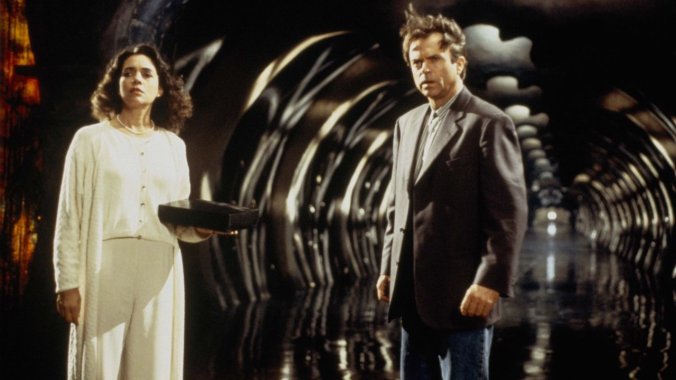
Then the 90s came, and he started to look like a director whose context had disappeared. This is not to say there weren’t fine moments to come—if you catch me with my guard down, I’ll even have pleasant things to say about Ghosts of Mars (2001). But the latter-day film a Carpenter buff is most likely to make big claims for is this 1994 horror show: In the Mouth of Madness. The good people at the prestigious Cahiers du Cinema, suckers for genre films with meta-subtext that they are, even voted it one of the best films of the year. It follows Sam Neill as an insurance investigator looking into the disappearance of a pulp horror writer—Stephen King as H.P. Lovecraft may have imagined him—whose writing is starting to break out of its fictional confines and effect the real world. Carpenter thought of this film as the finale to his thematic “Apocalypse Trilogy”, started by The Thing and continued with the underrated Prince of Darkness (1987).

You have to care more about horror paperbacks than I do to see this all as a canny prophesy instead of an idle game. But In the Mouth of Madness does have a very intriguing idea on its side: that a well constructed work of fiction can override your reality, even when you know it’s fake. And thus the best moments of the film come when it scares you (sometimes exquisitely) while making as little sense as possible. It works as well as it does by sticking with the spirit of Lovecraft’s short stories, in which a hero tries to rationally narrate his own story while clearly going off the deep end. And per Carpenter’s standards, it leads to a bonkers final scene that reminds me of what we always loved about him: that his genre films were very un-generic.

The scariest thing may be that 1994 FX now look like they’re entering the realm of camp. I was around in ’94, and it didn’t look that way at the time. An ill omen for the future, if there ever was one.

✬✬✬✩✩

*********

Halloween Countdown is an annual, personal, and highly unoriginal tradition where I write fast, extemporaneous reviews of 20 prominent but random horror movies during the month of October.

Halloween Countdown: THE INNOCENTS

the-innocents

Nothing ages worse than horror, they say. And they’re not wrong. So when I popped in a copy of The Innocents a while back, knowing absolutely nothing about it, I was expecting a fairly low-key evening. After all, gothic horror is by definition old-fashioned, and how scary could a haunted house movie made in 1961 be?

Two highly disconcerting hours later, it turns out that the type of horror movies that age are the ones that revolve around a very contemporary type of shock. But aim for the subconscious, and you get something timeless. All you really need are lights, shadows, the right pacing, a good actor’s face, a subtext that corkscrews its way into your mind, and a director—like the estimable Jack Clayton—who knows how to use them. The Innocents has all of these in spades: its total death toll is one, and I suspect it will continue to be scary long after our jaded, bratty grandchildren find Eli Roth torture porn boring and tame.

The plot is about a repressed governess sent to a remote manor to look after two small children. Only, as isolation sets in, she begins to suspect the children are possessed by some horrifying evil force. The atmosphere is exquisitely frightening and irrational, full of weird choices, like casting the 40-year-old Deborah Kerr as a sexually repressed 20-year-old, that make you question your sanity. It’s enduring triumph is asking if ghosts exist only in mind—and that if they do, maybe that alone is enough for a haunting.

✬✬✬✬✬

********

Halloween Countdown is an annual, personal, and highly unoriginal tradition where I write fast, extemporaneous reviews of 20 prominent but random horror movies during the month of October.