Short Cuts: GOOD TIME

good-time

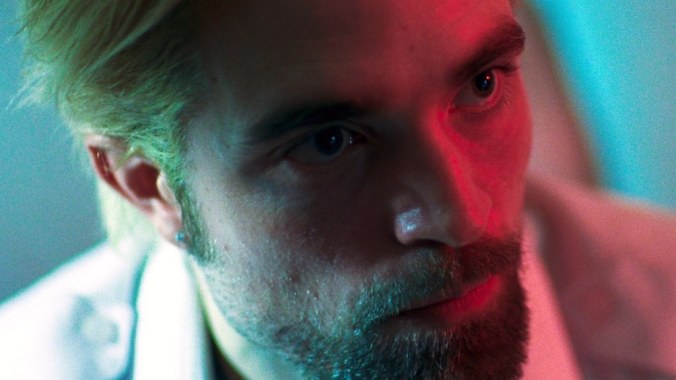
In the end credits of the Josh and Benny Safdie’s Good Time, the first name to appear under the special thanks is Martin Scorsese. I don’t know what went on behind the camera, but they’d owe him that much for Mean Streets (1973) alone; like a classic Scorsese crime picture, Good Time is about reckless hoodlums who are almost smart enough to realize how dumb they are. Robert Pattinson stars as Connie, a New York City kid who ropes his mentally handicapped brother Nick (Benny Safdie, stepping in front of the camera) into helping him commit a bank robbery. When it goes south, Nick is caught and thrown in prison, and Connie spends a long night bouncing through the outer boroughs in a series of increasingly desperate, ill-advised plans to score some cash to get him out, with dawn and inevitability on the way.

It is a film with style to spare, full of rave colors, sharp editing, and a few stunningly controlled helicopter shots. And fittingly, the key question hovering over the film is the same that has hounded Scorsese, and that’s whether or not there’s more to the film than just an invigorating shot of pure cinema in the arm. There is: to its credit as a film, Good Time is not a good time, but a bad trip laced with social criticism and MDMA. It is an overload, a discomforting vision of America’s strivers, fuck-ups, and have-nots, precise and convincing in its earthy detail of mid-to-lower-rung city life. (Essays can be and have been written on which characters the Safdies make white or black, as class throws the two into the same boat but race keeps them judged by different standards.) As an actor, Pattinson has been looking for arthouse cred for a while now—just like fellow Twilight star Kristen Stewart—by working with directors like David Cronenberg, Werner Herzog, and James Gray. And it’s to his credit that by the end, what starts looking like a “a bunch of authentic New Yorkers plus an English matinee idol” ends with him having disappeared into the role. Besides, you’d need the looks of a matinee idol to get away with half of the scams he attempts.

The harsh, jagged nature of the film has its limits, particularly for a film whose biggest flaw is how it keeps you at arm’s length while yanking the chain. (That is, if a film isn’t at least half-interested in tenderness, you can easily spend two hours watching anti-heroes ruin their lives without growing to know or care for them.) But the finale, in which the two words of the title are spoken, suggests an ambivalent moral that the only responsible path forward in life is not fast or exciting but drab and dutiful and banal. A Scorsesian theme if there ever was one, and enough to say that the Safdies’ neon odyssey, already showered with cinephile acclaim, could be the breakthrough of an outstanding body of work. Scorsese himself has signed on as an executive producer of their next film. Fingers crossed.

✬✬✬✬✩

********

Good Time was a darling at the Cannes Film Festival last May and is now available for download. Keep it legal, please.

Short Cuts: THE SQUARE

image-w1280-1

There are many delicious ironies inside and encircling The Square, the cringingly funny new comedy by Swedish director Ruben Östlund, not least of which is that it won the top prize at the Cannes Film Festival. Cannes is a place both magical and insane, a hotspot of global prestige where for two weeks each May, aspirations of important, global cinematic art mingle with crass elitism, conspicuous consumption, and institutional absurdity. So where better to celebrate the story of Christian (Claes Bang), the anti-hero of The Square? Christian is the curator of a museum of contemporary art in Stockholm; the number one obstacle is money, he explains early on. Hiply dressed and doing his best to dodge his own faults, he juggles his day-to-day job, his nights at parties, his young daughters from a previous marriage, a reporter he slept with (Elisabeth Moss), an encounter with a pickpocket, and the problems with the museum’s new installation. The installation is called “The Square”: a physical space where all people are equal and must be humane to each other—a concept that proves difficult to concretely explain, and even more difficult to market.

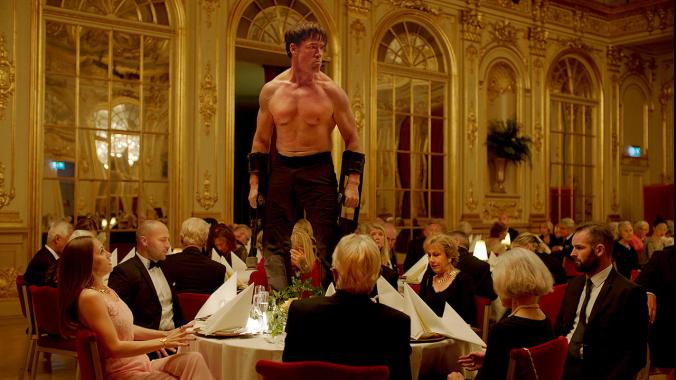
Östlund had a breakout of sorts with 2014’s Force Majeure, and The Square continues that film’s way of breaking people down, particularly men, into creatures with absurd atavistic instincts barely covered by even more absurd public facades. The Square is nothing if not a string of not-at-all-subtle comic setpieces to that effect, including a violent performance piece during a black-tie dinner party (Buñuel would be proud) and a Q&A with a conceptual artist (Dominic West) who keeps being interrupted by a man with Tourette’s syndrome. The concept at the center of all this is delightfully droll: the idea that serious introspection and universal empathy—which, in a perfect world, we would all practice anyway—can be turned into the kind of artistic event that only the rarefied would even attend, let alone be effected by. Art-world pretension is a fish in a barrel if there ever was one, and to the film’s credit, Östlund has his sights on something larger: class-conflict, poverty, and the idea of a utopian society that has evaded even a place as progressive as Sweden. Christian is callow, irresponsible, and self-centered, but the film works because Bang is affable enough to keep the movie from condescending. Christian is both a cad and an innocent; his mistakes are mistakes that anyone in his position might make, and his humbling is not one we’re meant to take snide pleasure in. (“You must think very highly of yourself”, Moss says to him at one point, to which his response is an instinctive, strikingly sincere “I don’t”).

This is an idea whose weight the film doesn’t do full justice to: that idealistic humanism and absurdist cringe-comedy should be forever bound together, because we are, on the whole, a very absurd species. The Square‘s level of insight into said absurdity, either for the art world specifically or humanity in general, is thin for a movie that stretches for two and a half hours. Like Force Majeure, it ends on a weaker note than it begins, as if Östlund the dramatist is better at spotting our foibles than coming up with emotional, weighty, meaningful conclusions for them. But as a humorist, he’s a shrewd adult who hasn’t lost touch with his inner child, and that inner child is a very naughty prankster. As the various ideas of this deadpan comedy diffuse, the most lasting ones are that low-brow entertainment can do more than art, that truly effective art has to be dangerous, and that—in a world of pretensions and poses, of problems that have no perfect solution, of political arguments where it’s impossible to please everyone—the most honest form of human expression is an awkward breakdown. I’ll drink to that. Skål.

✬✬✬✬✩

********

The Square was nominated for Best Foreign Film at the Golden Globes. It’ll be available on iTunes by the end of the month, if you want to wince in the privacy of your own home.

Short Cuts: I, TONYA

i-tonya

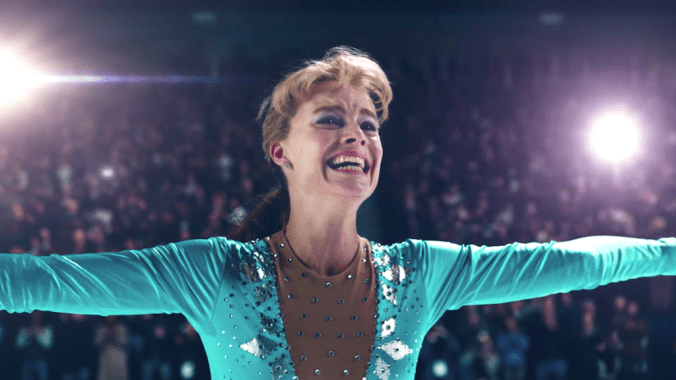
The opening titles of I, Tonya—a dark comedy about the life, times, and scandal of figure skater Tonya Harding (Margot Robbie)—inform us that it is based on the “irony free” testimony of those involved. It’s both a joke and a boast, and “irony” quickly becomes the operative word; the landing that I, Tonya needs to stick is to convince us that there’s more to this biopic than the thick syrup of irony it ladles over every detail of its true story. There is an attempt, to be sure. But by the final act, the film has established itself as perhaps the most fraudulently entertaining film of 2017, a have-your-cake-and-eat-it-too movie that tries to tap into the untold pathos of a tabloid celebrity while parading everyone as a comic freak show. It toggles back and forth between its modes so fast that it can give you whiplash—there’s no idea so serious that the movie can’t tactlessly undercut it almost immediately.

For those too young to remember the 90s, Harding was an Olympic figure skater who was implicated in the maiming of Nancy Kerrigan, one of her rivals. The facts of the case are stranger than fiction, and the rumors worse. As for the film’s telling, it certainly can’t be faulted for acting or technical skills. Allison Janney (as Tonya’s maniacal, chain-smoking mother) will probably get an Oscar nod on the basis of profanity alone, while the camerawork and editing are forceful and exhilarating, particularly during any scene set on the ice rink. What it lacks is a coherent, consistent perspective on its subjects. More than one reviewer has favorably brought up Martin Scorsese, which is a sign of how superficial critics can be: I, Tonya has the tracking shots, needle-drops, and broad strokes of a Scorsese film without realizing just how much Scorsese’s style and themes worked together. (As excessive as they are, Goodfellas, Casino, and The Wolf of Wall Street are nothing if not carefully, expertly balanced between seduction and moral dismay).

It’s a shame, because I, Tonya is correct when it says at the beginning, with its characteristic lack of subtlety, that the story of Tonya Harding is a story of America and a story of the pressures put on women. There’s plenty of narrative material to back up both, and I can see why Margot Robbie, who is also credited as a producer, was drawn to the material: it’s a chance to play an unconventional heroine and give a swift kick in the balls to anyone who thinks she’s mere eye-candy. Her big scene at the end—in other words, the landing—deserves to be in a much better movie. The most honest moment may be when Bobby Cannavale, as a reporter for Hard Copy, says that mainstream news outlets have now become as trashy as the gutter journalism of the 90s. That, if nothing else, is the implicit moral of I, Tonya: I’m sick, you’re sick, they’re sick, we’re all sick, and we can all be manipulated by the media—now enjoy this crane shot and laugh and be moved. There’s no way on Earth that I, Tonya will bore you. But if you think about it enough to scratch just below its surface-level effect, it doesn’t cleverly prove that point so much as it clumsily embodies it. Frankly, I’d advise not giving it the satisfaction.

✬✬✩✩✩

*********

I, Tonya is in select theaters now. Margot Robbie is wonderful in it, but people who forget it understand it best.

Short Cuts: CALL ME BY YOUR NAME

call-me-by-your-name

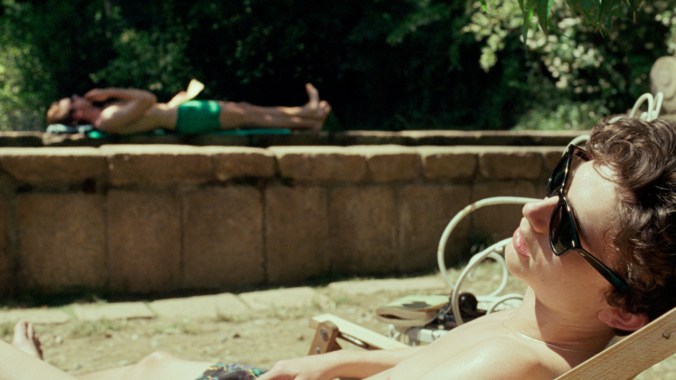
Even if you’re allergic to that arthouse subgenre about bourgeois European intellects who have nothing to do with their summer except dine al fresco, philosophize about western civilization, and decide who to have sex with that night, you owe it to yourself to check out the loveliness of Luca Guadagnino’s Call Me By Your Name and draw your own conclusions about the hype. Looking at its list of ingredients, the easiest point of comparison is Eric Rohmer—so easy, in fact, that it’s worthwhile to jump at it and note the differences. The heroes and heroines of a Rohmer film are at least halfway preoccupied with theory; that is, they have hearts and libidos, but will talk themselves into logical knots trying to rationalize what they do or don’t do. Call Me By Your Name is less concerned with rationality or rationalization. It is a film that dives headlong into pure sensuality: beautiful scenery, beautiful houses, beautiful works of art, beautiful women, beautiful men, beautiful words (a script by James Ivory), and beautiful music (courtesy of Sufjan Stevens).

Set in the the early 1980s, the plot is the brief, blossoming love affair between a teenage boy (Timothée Chalamet) and an older grad student (Armie Hammer) who comes to stay at his family’s villa in the Italian countryside. It is a movie about homosexual awakening, though most of the politics of an LGBT identity—each hero has affairs with women as well as each other—is largely absent. (Guadagnino has been criticized for discreetly cutting away from outright showing gay sex, which is a fair point, though I doubt homophobes and insecure masculinities will be comfortable with what he does show, even when it’s just a boy alone with a peach). For my money, the film’s philosophy is more the capital-A Aestheticism of Oscar Wilde and Dorian Gray: the idea that you should follow your desire for new sensations to wherever it leads you. It is also an extremely generous film, a showcase for all involved where no one hogs the spotlight. Chalamet is as much the breakout star as you might’ve heard. Hammer is fine in a role that calls for being handsome, aloof, and unreadable. Guadagnino’s direction keeps everyone in precise relation to one another. Sayombhu Mukdeeprom’s cinematography is glowing and immersive. Sufjan Stevens’s piano score pairs well with so much sunlight reflecting off a lake. And Michael Stuhlbarg, as Chalamet’s father, gets to deliver the speech that gives the story its moral: that opening yourself to life’s experience means embracing all the emotions that come with it. With all these elements in such elegant arrangement, the 130 minute runtime flies by, and it sticks in your memory like a summer vacation you never had with a group of friends you never met. As good as it is, I’m not convinced the film escapes its own rarefied atmosphere, or that it ultimately leaves you with more than an emotional trip. But such trips are to be treasured, and it’s a major Oscar contender for a reason. Its virtues and limitations are no less, and no more, than those of beauty itself.

✬✬✬✬✩

********

Call Me By Your Name is in select theaters and up for a boatload of Golden Globes.

Short Cuts: MUDBOUND

mudbound

It’s one of the most famous lines in Hollywood cinema: Norma Desmond, movie queen of the silent era and the anti-heroine of Sunset Boulevard (1950), flares her nostrils and declares, “I am big! It’s the pictures that got small.”

She never lived to see Netflix.

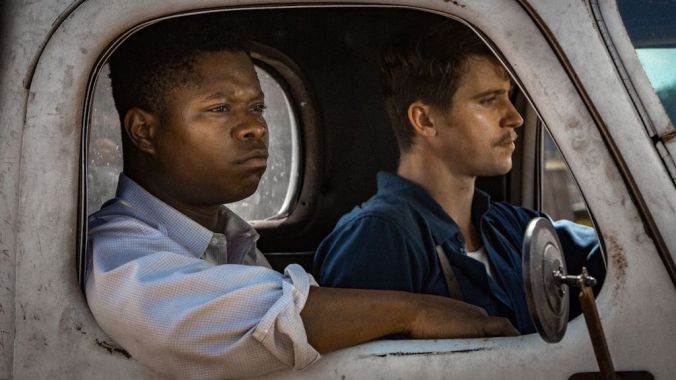
Streaming services, Netflix chief among them, have revolutionized the way television content is produced and consumed, but movies have been a trickier debate, even as the line between “TV” and “cinema” gets blurrier by the year. One reason Amazon beat Netflix over the finish line as the first web giant to win a top Oscar—with last year’s Manchester by the Sea—is that Amazon still treats films as a theatrical event. The challenge that Netflix has set for itself is finding a way to virtually skip the theatrical window, go right to your TV and mobile devices, and somehow shake off that direct-to-video stigma that can make a movie feel small. And make no mistake, Mudbound, Dee Rees’s new film and Netflix’s gambit for Oscar season, is the sort of film that needs to feel big. It’s a historical/literary period piece that spans years. It is a two-hour-plus story that straddles a historical fissure (World War II, in fact, the Academy’s favorite historical fissure). It tackles the social issue of American racism. It films the heartland sunrise in CinemaScope. It jumps back and forth a few times between continents. And it features an award-eligible original song, played at the end for your consideration.

But even setting aside how Mudbound is distributed and received—which, to be fair, may wind up the most consequential thing about it—it is a film that wastes too much of what it does well. The greatest strength of this tidy epic about two families in the Deep South, one black and one white, is its Faulknerian dedication to multiple point of views. It trades off inner monologs and voice-overs, mapping how the world of the film looks if you’re young or old, male or female, rich or poor, black or white. But its sense of time and place is thin. It can’t consistently fool you into thinking you’re not watching actors in costumes. And by the end, it has dived into the melodramatic hand-me-downs that have haunted the Academy stage since at least Sophie’s Choice: that is, Mudbound feels like our era’s version of an earlier era’s version of an earlier era. Even as it goes for a violent gut-punch near the end, I’m not entirely convinced this kind of period piece is the most effective way to provoke a dialogue about race in America in 2017. A bizarro genre film like Get Out—whose villains aren’t mid-century brutes with Mississippi drawls, but a left-leaning white upper-class that’ll swear on its heart that it loves black people—is so much better at stirring the pot.

By comparison, the world of Mudbound, multiple perspectives and all, is frozen in sepia and converted to a digital copy. It is not a film without impact. It has characters, it has an arc, it has a destination, it has a certain soap-operatic intrigue, it has an ambition towards complex humanism. When it is content to quietly smolder rather than yank, it has moments that strike home. But at least 40% of it feels like it could have sprung, fully formed and without an individual identity, from the collective unconscious of Oscar season itself. That the film has arguably accrued more year-end prestige than any Netflix movie so far may be its biggest irony: a still-early trial balloon for the model of the future has one foot so utterly tethered to the old-fashioned.

✬✬✬✩✩

*********

Mudbound premiered at Sundance and was given a small theatrical release to qualify for awards. It currently lives on Netflix.

Short Cuts: THE SHAPE OF WATER

theshapeofwater

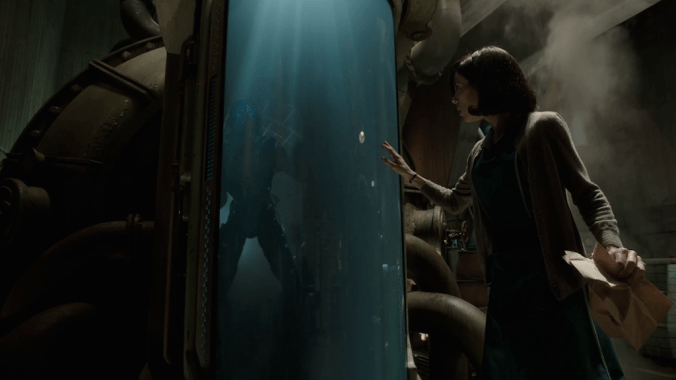
With Tim Burton fooling around and Terry Gilliam still living under a question mark, Guillermo Del Toro stakes a claim to being our finest practitioner of modern fairy tales, a director who can fade in on the world of automats and Cold War paranoia with an atmosphere that immediately and beguilingly says “once upon a time…”. So if you’re wondering what Cinderella would be doing in the early 1960s, Del Toro’s The Shape of Water has an answer: she’d be living above a grand movie theater and working as a maid at a secret government research facility. She is, as played by Sally Hawkins, a mute, and a delicate, private, and timid individual. After her G-man bosses capture what looks uncannily like the creature from the black lagoon—one of Del Toro’s favorite movie monsters—she and the creature bond as fellow outcasts, and an escape plan is hatched.

To put it mildly, Del Toro has great tenderness for cinema’s monsters, so it’s only fitting that he use one as a symbol for America’s disenfranchised communities, be they racial, sexual, or economic. That social commentary is more or less safe, tidy, and unremarkable; pointing out that America was a regressive place during the Civil Rights era is, these days, like shooting fish in a barrel. But without spoiling anything, I wonder what on Earth the studio thought of at least two sequences Del Toro devised for his silent aquatic hero, both of which double down hard on the film’s heartfelt predilections. And that gets to The Shape of Water‘s greatest strength: it so clearly comes from such an utterly singular consciousness, a cinephile mind in love with both plucky B-movie weirdness and luxuriant A-movie craft—and a mind that believes that the most pitiable monsters might be humans. Much like Cronos (1993) and The Devil’s Backbone (2001), two of Del Toro’s earlier fables, The Shape of Water is not a lean, mean suspense machine or an airtight plot. (More than once, you may find yourself marveling at how lax the security at this government facility really is). But it is laced with details, themes, characterizations, and subtle morality plays that make it linger pleasantly in the mind. As the film’s villain, Michael Shannon could fulfill his plot function simply by growling, but the scenes Del Toro includes of his personal life—the straight-society alpha male who wants everything he’s supposed to want—make his character as pathetic as he is menacing. (Both he and Hawkins spend the movie carrying a physical scar or deformity, and how each wound turns out is bizarrely poetic in its sincerity).

What results, as the film fades to black, is a risky pastiche of genres, elements, and tones, and I haven’t told you the half of them. But the film works as well as it does because, like an Old Hollywood classic that might play at Sally Hawkins’ nearby movie theater—this fairy tale’s true enchanted palace—The Shape of Water holds so purely to its convictions: that an outlandish monster can open a serious metaphor, that color should be splashed across the screen with gusto, that bedtime story logic might follow us into the world of modern genre cinema, and that the filmmakers, star, and story can unironically hurl themselves at the unexplainable in the hope of a happily-ever-after.

✬✬✬✬✩

********

The Shape of Water is now playing in theaters and is nominated for Best Picture at the Golden Globes. Bless it when something this strange gets bestowed with prestige, and I hope the Academy tosses a nod to Shannon as well as Hawkins.

Away From the Breach: DUNKIRK and Christopher Nolan

dunkirk-2017-large-picture

Over the last ten years, Christopher Nolan has become perhaps the closest thing Hollywood has to a tentpole director with a blank check. So, with curiosity, earlier this year I took a look back at Following, his 1998 debut, a fractured and scrappy modern noir made in the UK for $6,000 before Nolan had turned thirty. It is a remarkably skillful beginning, and it shows how many of his virtues, vices, and trademarks were there from the start: an addiction to non-linear narrative, a dark fascination with moral compromise, an eye for slippery editing, an ear for rattled anti-heroes, a few cheap tricks and small hiccups, and the gnawing, inescapable sense that the cynicism/fatalism of his cinema is not really worldly wisdom, but an aesthetic preference. And make no mistake: in an era when fans treat Nolan as one of Hollywood’s reigning geniuses, true wisdom remains the most underrated quality a film can have.

But looking at the structure of Following, in which a doomed man tells his tale, it struck me that the story-within-a-story format is very telling for Nolan. First, there are flashbacks to moments that the main character was present for (memory). Then, there are scenes from the main character’s story that he did not witness, but must assume happened (imagination, or some element of it). Last but not least, there is a final revelation that is neither narrated or witnessed by the hero, but presented to us as objective fact (let’s call it reality). And so, to tell its simple story, we juggle between the three realms, with different levels of subjectivity and none really distinguished from the other. But as impressive as Following is, digging so deep into its layers of narrative reliability may be giving it too much credit. By the end, there aren’t three kinds of perspectives. There is only one: Nolan’s, the all-seeing man with the camera, the sole presence in the film with all the answers, doling out information or twists to the audience in just the right amount—and in just the right order—to try to catch you off guard. He is, first and foremost, a purveyor of effective, clever, and dubiously meaningful narrative magic tricks. It’s no wonder that, for many cinephiles, including myself, it feels like his most personal work comes in the dueling magicians of The Prestige (2006).

About those cinephiles: for the last ten years, I’ve been stuck in the middle, caught between worshipful fanboys versus critic types for whom taking Nolan down a peg has become a kind of standard. As for the latter, I can understand it: Inception (2010), The Dark Knight Rises (2012), and Interstellar (2014)—his first three films after The Dark Knight (2008) made him an IMDb god—are his weakest films by far, overextended in their complexity, overhyped in their deeper meaning, and vague in their narrative mechanisms. But I’ll say this for Nolan: he uses the power of that blank check for good. In his ambition and dedication to the virtues of analog filmmaking, he’s worth tracking because he’s the only major studio tentpole filmmaker active today to reach so far.
BB-14

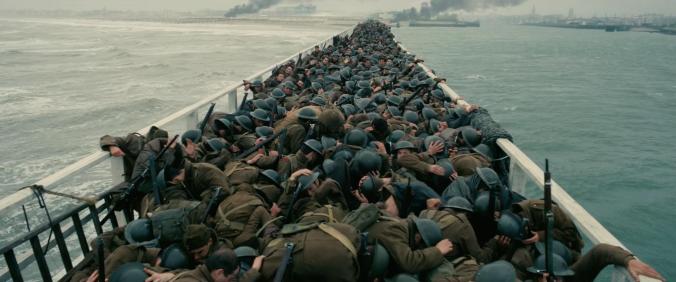
Part of that analog spirit is why Dunkirk, his latest film and a prime Oscar contender, is only coming out on home video now, when plenty of other summer releases became available to rent months ago. As part of the Oscar campaign—and, I would venture, Nolan’s personal taste—the film was rereleased in theaters earlier in December for select IMAX and 70mm presentations, before Blu-ray, iTunes, and Amazon Video viewers could get their hands on it. I was eager to see it, because it promised the end of a rut that needed to be shaken. It is Nolan’s first film in over a decade to be set in the real world, as opposed to a sci-fi or comic book world. It is his shortest film in a decade as well, and it’s a testament to the multiplex grandiosity of his last few films that this time-shifting, $100 million movie feels like Nolan has scaled back to basics.

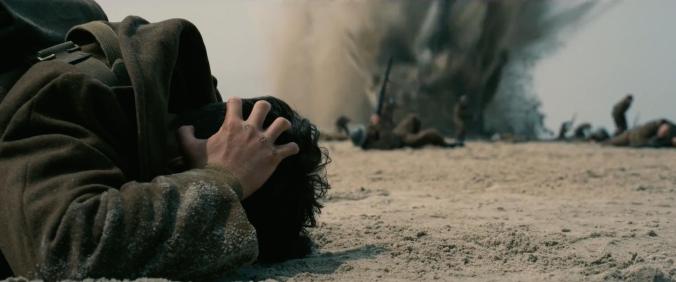
Set at the evacuation of Dunkirk during the early days of World War II, the film is an epic of survival and retreat, as half a million Allied troops, stranded on the coast of France, hold fast and wait for help from home. And of course—nothing being linear for Nolan, even history—the film intertwines three stories on three timescales: frantic troops look for a way off the beach (set over the last week before evacuation); a British civilian sails his boat across the channel to rescue as many men as he can carry (set over the last day); and an RAF pilot, running low on fuel, engages in a dogfight over the sea (set over the last hour).

The result is his first great film in ages. Watching it unfold, I couldn’t help but think of the omniscient Nolan of a film like Following—the all-seeing eye—because Dunkirk is material that calls for a certain Mount-Olympus point of view. Which is to say, Dunkirk overcomes most of Nolan’s weak points by either dodging the attempt or leaning into them so hard that they become strengths. It is a decentralized mood piece writ large, a relentless string of immaculately terrifying set-pieces to escape an unseen enemy, and a film that sustains high-wire darkness before giving way to the chance of mercy. It is above all a sensory experience, a kind of narrative soup where every figure is dwarfed and no one can claim to be the main character, not even a dignified Kenneth Branagh, a devoted Mark Rylance, or a shell-shocked Cillian Murphy. The wonky exposition of The Dark Knight Rises and Interstellar are not an issue; the underlying plot events of Dunkirk are pure simplicity, and its chaotic presentation feels both appropriate for a fog of war and increasingly lucid as the film goes on. Nolan’s last two films had blind spots when it came to nuanced psychology or seamless characterization. Here, there’s no need for either; it’s enough to know that these characters are people who face death and fear it. (Indeed, the film’s biggest stumbles come when it attempts to get more intimate than that). In the absence of so many of the up-close-and-personal elements of an epic drama, what that leaves you with is a distilled version of Nolan’s physical craft, which has never been stronger or more controlled, and an evocative sea of actors’ faces.

It is certainly a war movie for its time. “Survival is victory”, says the movie’s tagline, and the sentiment is echoed rather explicitly near the end, which finds Britain reflecting and regrouping. “Inspiring” is a word that tends to get thrown around a lot in Oscar season, and Dunkirk is, on the face of it, the sort of inspiring “based on a true story” that Hollywood dreams are made of: Britain hoped to save 30,000 troops, and ended up saving ten times as many. But Nolan remains fascinated by compromise, and there is a certain conflicted passion to the way it comes to a close. Dunkirk runs its characters through a gauntlet of some very un-heroic emotions, and ends with one of them—nobody more or less remarkable than one soldier among many—reading aloud Churchill’s famous “we shall never surrender” speech while the music swells.

Are we meant to find it inspirational? The simple answer is yes, of course, naturally. But all you need to do is set it side by side with, say, the Lincoln letter scene of Saving Private Ryan (1998) to notice that Nolan’s tone, and where he leaves his characters, is something different than just the typical piety—starting with the fact that the soldier reads the speech solemnly but without grandiloquence. Is he dazed? Weary? Optimistic? Nervous? Quietly resolved? All of the above? Contradictions can be found in reconciling the end with what came before it: war as a challenge that must be faced, as an ordeal that any sane man might run from, as a reverent demand for heroism, as a reality where survival matters most. (And, whether the film realizes it or not, as both a violent nightmare and a spectacle with an audience-friendly PG-13 rating). It is in this respect that Dunkirk, taken as a whole, comes shy of being a masterpiece, but provides one of the more valuable storytelling lessons of Nolan’s career: that the true measure of a film’s complexity is not its tricky structures, loaded mythology, or topical window-dressing, but the amount of opposing truths it can fit onto the same screen at once.

In other words, Dunkirk is, like any Nolan film, a clockwork mechanism. But it is built to leave you somewhat disoriented and suspended as well as moved, whereas someone like Steven Spielberg always left World War II, as both an event and an idea, tied in a neat little bow. Nolan may be the first director to try and reconcile the Spielberg of Saving Private Ryan with the Terrence Malick of The Thin Red Line (1998)—a cinephile divide if there ever was one—and the fact that Nolan even comes close is a remarkable achievement. Dunkirk isn’t a film without flaws, compromises, or contrivances. It doesn’t reinvent the World War II movie, which is a lot to ask, I know. But for now, it is one of the most potent movies for both its year and its director; it means more to me in 2017 than Private Ryan ever did. Skill with a camera was never Nolan’s problem, even when he was working on less than $10,000. But more than ever, Nolan and his considerable talents are closer to saying something magnificent than to performing sleight-of-hand.

✬✬✬✬✬

********

Dunkirk is now available as a digital rental, whether Christopher Nolan likes that or not. It will still feel intensely claustrophobic on a laptop screen.
Short Cuts: THE OTHER SIDE OF HOPE

the-other-side-of-hope

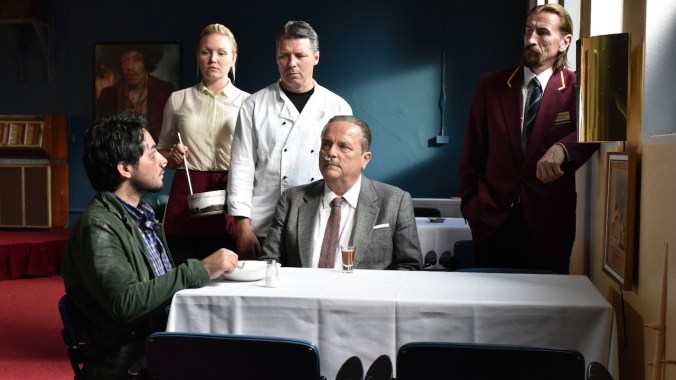
Can whimsy and social urgency mix? As a matter of principle, I see no reason why a topical issue can’t be heavily aestheticized—if done properly, it’s both more vivid and more honest than the pretension of “realism.” But doing so takes the greatest of care. That’s the thread walked by Aki Kaurismäki’s new comedy The Other Side of Hope, in which a Syrian refugee named Khaled, having fled the violence in Aleppo and been driven across eastern Europe, lands unceremoniously in Finland. Or rather, in Kaurismäki’s version of Finland: a place of chain-smoking cool, retro guitar licks, and rooms so color-coded that just about every scene includes a static composition that could be hung comfortably on a wall. (Kaurismäki’s deadpan sensibility makes him Finland’s Jim Jarmusch, though it may be more proper to say that Jarmusch is America’s Kaurismäki). Khaled, as played by Sherwan Haji, is something of a Buster Keaton figure: generally silent, physically small, expressively inexpressive, unfailingly innocent and honest, and ever-persevering through all the indignities, indifference, and injury that life—in this case, life as a refugee—throws his way. And fate has him set on a course to collide with a wannabe restauranteur whose morals are shady at best. The film often plays by screwball logic; characters will make a decision because that’s what’s required for comedy—and the way this mingles with the migrant crisis, including glimpses of real violence on the news, can make The Other Side of Hope a bit too arch or nebulous or listlessly trapped between tones. But as its plot threads come together and the film closes, it has become a truly uplifting comedy in the classical sense of the term, borne from the idea that people can go on, that locals aren’t necessarily more law-abiding than immigrants, and that maybe the system will get its shit together. The coda earns the word “hope”. Bless it.

✬✬✬✬✩

********

The Other Side of Hope is appearing and disappearing at arthouses across the country. If you have a chance, take it.

Short Cuts: RISK

risk

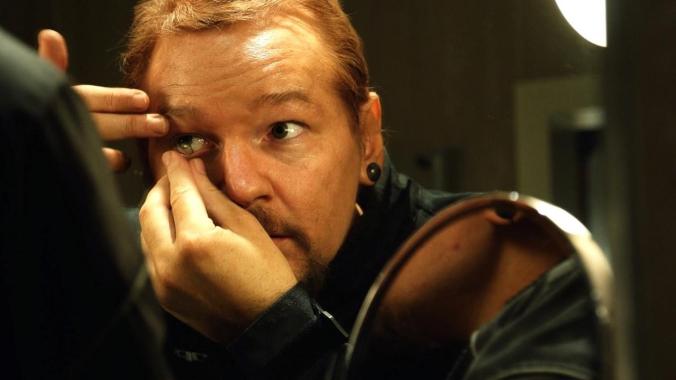
The making of Risk is far more interesting than the film itself, though in a way the two are one and the same. Director Laura Poitras, who won an Oscar for Citizenfour, originally premiered Risk—a documentary on Julian Assange and WikiLeaks—at Cannes in 2016. But then, in that insane year, circumstances changed: first when one of her interview subjects at WikiLeaks (a former lover, she reveals) was accused of sexual assault, and then when WikiLeaks played a key role in helping Donald Trump beat Hillary Clinton. With reality unfolding faster than her film, she went back to Risk after its festival premiere, added to it, and re-edited it. “This is not the film I thought I was making,” Poitras says in voice-over. Then what is it? The 2017 cut captures nothing so much as a sense of utter disorientation. The political becomes personal, but is Assange a hero, personally or politically? In the story of WikiLeaks, ironies abound: a martyr for many libertarians, progressives, and leftists helped elect the most reactionary American President of our lifetime. It all depends on whose secrets you expose, and to what end. After the DNC leaks, Sarah Palin went from calling Assange a terrorist to praising him for opening the public’s eyes.

As for Assange as a human being, Risk has only a limited portrait to work with. What comes across most in his direct interviews are calculated egotism, a hyper-awareness of public perception, and a grandiosity that fits whatever an anarchist’s version of “megalomania” is. Most of the film is, in fact, sparse and rather dull, detailing in a scattered way all of the backstory we already know: the rise of WikiLeaks, the contested Swedish rape allegations against Assange, and his asylum in Ecuador’s British embassy. But the final fifteen minutes of the film, ripped from last year’s headlines, are something potent. Some have accused Risk of having an axe to grind against Assange, beca8se certain scenes present a very unflattering view of his attitudes towards women. But I think it’s more complex than a hit job: what we have is a political filmmaker at the center of a spinning moral compass. Poitras is, to put it mildly, far from pro-establishment. In fact, she has a history of being monitored, detained, and questioned by the feds. But the conclusion of Risk, to the extent that it concludes at all, is a fear that the control of information in the digital age is too great a power to be entrusted to anyone. Whether it’s the NSA, telecom companies, the New York Times, Rupert Murdoch, or an organization ostensibly built to promote political transparency, there are agendas and motives that won’t be openly talked about to the public. Risk neither rails against nor unquestioningly supports WikiLeaks. It fears Trump and holds no affection for Clinton or the United States federal government. In the space in between, it ends up as one of the most coldly anxious films of the year.

Reality continues to unfold fast. Since Risk came out, it’s been revealed that WikiLeaks communicated and coordinated with the Trump campaign, with Assange’s antipathy towards American imperialism making strange bedfellows out of WikiLeaks, Trump, Putin, Bernie-or-busters, and your ardently Republican uncle. Risk‘s misfortune as a shaky, fitfully incomplete work of documentary cinema is that Poitras happened to make it too soon. America, Assange, Trump, and a global gallery of power players and activists are all caught in a whirlwind. Risk is just a brief, blurry snapshot of a story that’s far from over. Someday, it can be told in full. If nothing else, what a documentary that will be.

✬✬✬✩✩

*********

Risk is available wherever you can watch or stream Showtime.

Short Cuts: LADY BIRD

lady-bird

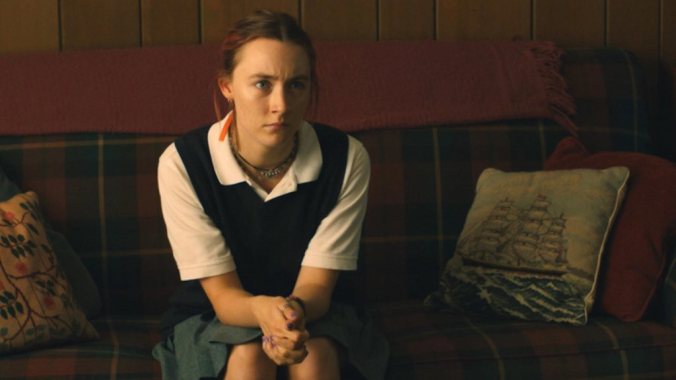
Don’t look back in anger—in fact, it may not even be possible to. That’s the main takeaway of Greta Gerwig’s semi-autobiographical and wholly delightful Lady Bird. It is a ceaselessly witty coming-of-ager, marking the directorial debut of an actress whose work—particularly as the muse/star/co-writer for Noah Baumbach—had already made her an indie darling of the 2010s. Gerwig and Baumbach’s latest films together were comedies set in the New York of so many millennial hipster dreams, to which Lady Bird is something of a prequel. We open in the suburbs of Sacramento, where a stifled, bored teenager (Saoirse Ronan) who insists on being called “Lady Bird”—her “given name” from herself to herself—dreams of leaving California and her Catholic school behind for college in New York City. The tightness of Lady Bird is part of the lost art of the 90 minute movie, which, thanks to sharp writing, gives the film plenty of time to delve into mother-daughter dynamics, the class divide at private schools, and how NorCal can be a really uncool place even when it’s trying hard not to be. (The word “hella” gets the ironically unironic line-reading it deserves).

As a comedy, it is one of the best of the year, carried by the fast dialogue and chemistry of the cast, with Ronan as the authentically spunky, back-talking teenage heroine that Juno couldn’t match in her most ostentatious dreams. But the chipper speed of Lady Bird serves another function, I think. As the film flips so quickly through the calendar year and its rites of passage—college applications, driver’s tests, school plays, identity crises, losing your virginity to a pretentious ass—it adds to the film’s air of fond, retrospective distance, as if to say that any conflicts, failures, and humiliations will turn naturally into comedy once they’ve shrunk in time. (Tellingly, the tempo only really slows down for the finale, and in a nice touch, the movie ends with its heroine in mid-breath). Oscar buzz has already begun; for those keeping score, Lady Bird was one of the ten top-grossing movies of last weekend despite playing in less than 40 theaters. Backlash will follow, I’m sure. The film telegraphs far more than it needs to, it could do more with its most distinctive ideas, and as both teen dramedy and “indie” cinema, it colors firmly inside the lines—to put it simply, there’s only so high a movie content to stick to convention can rise. But Lady Bird remains a joyful success on those terms and hopefully not the last we’ll see of Gerwig as a writer-director. It is a bittersweet farewell to the idea of a hometown: to hers, to mine, possibly to yours, and resonant for anyone who gets out only to realize that it will always be with you. For better or worse.