Short Cuts: FIRST REFORMED

first-reformed

Yes, video stores still exist in LA, and they have a purpose, both as a repository for films abandoned by the streaming boom and a forum of ideas for the geeky, the devout, and the reprobate. At one of them, I mentioned to the clerk that, with First Reformed, writer-director Paul Schrader seemed to be having a moment again for the first time in years. He agreed, then asked me about Ingmar Bergman’s Winter Light. “Did you see Winter LightFirst Reformed is basically 70% Winter Light.”

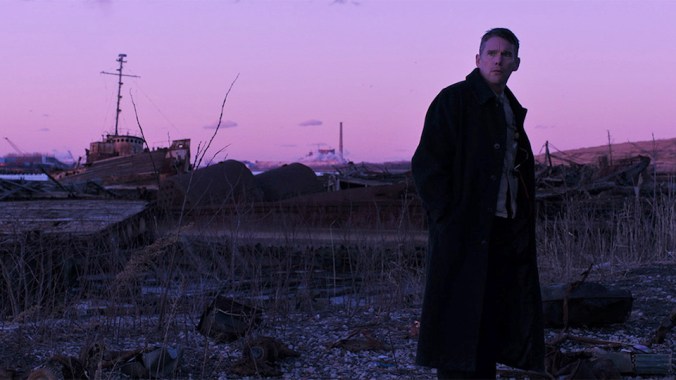
Having seen both, that number sounds correct, and I’d add that a lot of the remaining 30% belongs to Robert Bresson’s Diary of a Country Priest. (Schrader, in his life as a critic, literally wrote the book on Bresson, before writing the script for Taxi Driver and having a directing career of his own). Schrader’s country priest takes the form of Ethan Hawke, who enters humbly as the pastor of a dwindling church in upstate New York. He is a sickly, solitary individual who hides most of his thoughts from others, as if he’s determined that his convictions must require loneliness. And his crisis of faith—not in god so much as in mankind—intensifies when one of his parishioners, distraught over environmental pollution, loses the will to live and leaves behind a widow. (In Bergman’s telling, it was fear of the atomic bomb).

There is a certain audacious reverence in lifting so much, particularly in a year when Bergman retrospectives have been touring American rep houses. But then, America makes a fertile and rewarding place to move the religious traditions of arthouse past, where Schrader’s anti-hero can serve as a soulful counterweight to megachurches and so much Christian kitsch. In a year when Wes Anderson pastiched Kurosawa with stop-motion dogs for the inner-children of twenty-somethings everywhere, the un-hip, anachronistic man-and-god sincerity of First Reformed not only has its own distinct power, but is something to be treasured. Schrader is a terrific storyteller, and don’t miss how much his style can contribute. The look of the film plays a muted color scheme, shot in the Academy ratio and lit like Dreyer (another Schrader favorite), against unnatural neon colors that feel sickly and toxic in comparison—like the sight of a cloud of Pepto Bismol in a glass of liquor.

Hawke is wonderful and against-type, though so recognizable that you can see why Bresson wanted unfamiliar faces to play his modern-day pilgrims. I’m not sure Schrader sells the environmental theme as more than a plot device—but then, committing suicide over nuclear anxiety always struck me as a bit histrionic, and Winter Light is safely considered a classic. The part of First Reformed bound to be most divisive is the ending, which deserves controversy not over whether it’s too bloody, too shocking, or too lurid, but whether it comes across as silly. (Surely a doomsday sign that the world is more jaded now than it was in Bergman’s 1960s, or even Taxi Driver‘s 1970s). But it’s the film’s own. And it sells—or, to use a more deservedly pure word, it offers—an idea worth pondering: that in the face of spiritual and psychological hopelessness, desperation and carnality are what keep you going. And what’s more, they may not even be sins. A theme that Bergman would have appreciated.

✬✬✬✬✩

********

First Reformed is currently available on home video and video-on-demand. For what it’s worth, the clerk liked it too.

Hall of Mirrors, House of Horrors: Spike Lee and BLACKKKLANSMAN

blackkklansman

Cinematically speaking, 2018 began with Ryan Coogler’s Black Panther, whose runaway success occasioned think-pieces, analysis, praise, and/or criticism from everyone from Slavoj Žižek to random bloggers (including an after-the-fact one by yours truly). It’s certainly worth considering what that movie and its phenomenon mean, because no matter who its superhero is named after, Black Panther is not a film with radical politics. Almost none of it is truly confrontational, a lot of it is the opposite, and that’s part of its reason for existing. It’s not anti-establishment; it just wanted, and scored, a seat at the establishment’s table.

For Spike Lee, however, confrontation has typically been on-brand. And while it would be reductive to ignore the less overtly political trademarks of “a Spike Lee joint”—film school cinephilia, theatrical performance, sexuality, musical numbers, a hometown boy’s love of New York City—it would also not be unfair to say that for the last decade or so, Lee has drawn more attention for the public tiffs he’s landed in than for the actual movies he’s made.

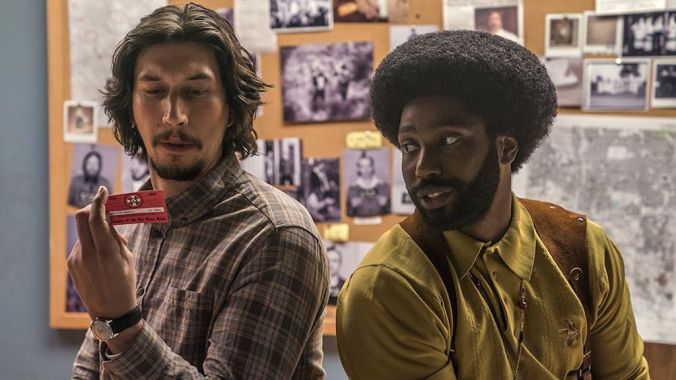
BlacKkKlansman is being hailed as a career highlight and return to form, and rightly so. Jordan Peele, on hand as producer, pitched it to Lee in what Lee called “very high-concept” terms: “black man infiltrates KKK.” The man was Ron Stallworth, a Colorado Springs police officer who made contact with the Klan in the 1970s. John David Washington plays Stallworth, who is at first assigned to investigate black college activists before turning department resources to the local KKK chapter. Adam Driver plays the white officer who serves as his in-person front. And, in a fine touch of casting, an appropriately milquetoast non-ubermensch Topher Grace plays Klan Grand Wizard David Duke.

The result is a fittingly brash approach to docudrama: part comedy, part cop movie, and part sociological horror show. But I fear that it isn’t just that Lee and his collaborators have been inspired to make a terrific film, but that mainstream American political life has given them the context in which to do so. This is 2018: our public discourse has long since blown passed preaching to the choir and is focused on galvanizing it instead. Into this rabid media landscape comes Lee, with a younger man’s passion and, crucially, an older man’s wariness. And it seems to me that of all the unsubtle statements for our unsubtle time, BlacKkKlansman has the distinction of being one of the subtler—or at least, one with some of the richest ideas. It’s not a masterpiece, for those keeping score. Yet no other American film so far this year is as worth talking about.

It certainly doesn’t hold back its thoughts on our era. And, as a (white liberal) cinephile, I have less use for the redneck villains’ explicit Trumpisms—”America First”, returning the country to “greatness”—than I do for the comparatively nuanced dialectic between the hero and his radical student girlfriend (Laura Harrier), who spend the film in an unresolved and unresolvable argument about whether or not the system can be peaceably reformed from within. (One scene references the term “super-predators”, a racially-charged quote that you may remember haunted a 2016 candidate—and it wasn’t Donald Trump). Those are the politics, but then there’s the scope and the method. This is all “based on a true story”, and not often does that phrase so shrewdly or brazenly contextualize itself.

That is, in addition to being a comedy, a cop movie, and the best script Lee has gotten his hands on in years, BlacKkKlansman is something else. It is a movie about movies, from the rose-tinted Confederate nostalgia of Gone With the Wind to the racist frenzy of Birth of a Nation to the complex legacy of blaxploitation. As a comedy or cop drama, it’s solid. As a pastiche of where pop culture and politics overlap, it achieves a lucid agitation, mixing the Old Hollywood canon, contemporary documentary footage, genre kicks, an Alec Baldwin comedy sketch (hello, Trump-era SNL), and a debate about Shaft vs. Superfly into a clash of history lesson and self-conscious cinematic fictionalization. It’s vital, then, to see Lee not just as a storyteller but an archivist. The use of Birth and Wind can suggest that if the white villains of BlacKkKlansman seem like inhuman caricatures of white hicks (and they are), it’s not as if Hollywood has historically done right by the black community. When Washington and Harrier hit the dance floor to the tune of “Too Late to Turn Back Now”, it’s the film’s most beautiful moment not because it’s their love affair with each other, but because it’s the movie’s love affair with a space they can call their own. And when Harry Belafonte appears in an extended cameo, the instant gravity comes not from who he plays—a fictional composite of civil rights leaders—but from who he is. This is the American screen as a hall of mirrors, some ostensibly clear, some proudly idealized, and some grotesquely distorted, with the insistence that each reflection be taken seriously.

So the best way to view this “very high-concept” movie is that it’s a movie that knows it’s a movie, and that certain pleasures and dangers are its heritage. It wildly embellishes its true story with scenes of made-up suspense and crowd-pleasing comic triumph—and tellingly, the liberties that have drawn criticism as such also got applause from the theater I saw it at in West LA. But the whole experience, particularly the controversy-inviting ending, asks you to be careful where you try to draw the line between what’s “just a movie” and what’s something more. BlacKkKlansman is structured literally as connective tissue between Hollywood myth and your online newsfeed, and you should beware, because anything that’s “just a movie” can be quickly taken away.

What is the film’s agenda? Not having Trump in the White House would be nice, but BlacKkKlansman is under no illusions that the problem began with his political career or will end with it. Considering what a target it has in President #45, the film’s perspective is expansive rather than narrow: its subject is a continuum, and Trump, Stallworth, Duke, the black power movement, the modern police force, and the movie business are all just parts of it. The film saves its key image for the end: Washington and Harrier moving down a hallway with their guns drawn, one in the name of the law, one in the name of her community, and both confronting a threat that might only go into remission for so long before it comes back again.

This places Lee back in the place where the political side of his cinema is at its most rewarding: confrontations and contrasts without easy, simple solutions. Solutions are close to reassurance, and no provocateur worthy of the name would peddle such a thing. BlacKkKlansman‘s accomplishment as cinema is to make visceral what might otherwise be removed into the world of history or theory. And if its tactics rub you the wrong way, run with that feeling, because dismissing it would be even worse. It starts close to the edge of what’s comfortable for laughter or suspense (or even choir-preaching), and by the end has gone so far beyond that that you should feel shaken and a bit conflicted at how you got there. And it says, among other things, that laughing at an Alec Baldwin skit won’t do a damn thing. A clarion call for its audience if there ever was one.

✬✬✬✬✩

********

BlacKkKlansman is currently in theaters around the country.
Short Cuts: LET THE SUNSHINE IN

Let-the-Sunshine-In-2-1600x900-c-default

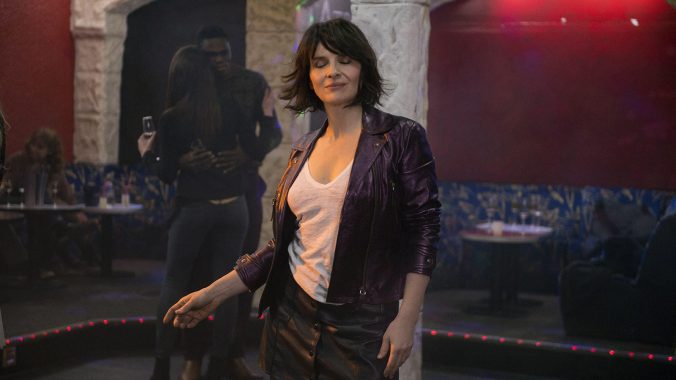
Claire Denis’ new film, Let the Sunshine In, is irritating. I don’t mean that as a criticism—at least not entirely—but rather as a simple statement of fact, because I gather that a certain degree of irritation or frustration is what it’s going for. The story follows a middle-aged French artist (Juliette Binoche) as men come in and out of her life in a pattern of hope, sex, love, and caprice. In one scene she’ll be happy with someone, the next scene she won’t. She’ll insist she isn’t looking for a fling, then immediately dive into one. She’ll deny that something bothers her, then turn around and say that it does. Most of all, she deserves better: of the men on her platter, none are particularly vivid or different from one another. Anyone who’s been in the dating world and is over thirty (hell, twenty-five) might recognize that this all sounds very true to life, even profound—at least, in theory. In practice, it can be a 90 minute slog in the company of characters whose behavior wavers between complex, which is good, and incoherent, which isn’t. This means that, even while it offers the surface pleasures of Mme. Binoche (as glowing as ever) and cinematographer Agnès Godard (making the city glow with her), theory is still where its principle appeal lies.

So if you’re familiar with Claire Denis’ films, you could be forgiven for looking at the first act and thinking that she’s actually given in and made an expected kind of straightforward bourgeois art film. Let the Sunshine In is neither elliptically edited (like Beau Travail or The Intruder) nor transgressive (like Trouble Every Day or Bastards). But it reveals itself as a structurally mischievous work, a film of such circularity and loose ends that it’s a middle without a beginning or an end. The film’s saving joke is its last one, where we suddenly dip into the lives of new characters who’ve had their own unseen version of the movie running parallel the whole time, and where the whole farrago of romantic confusion continues even as the credits roll, as if this routine can outlast not only your patience but even its own movie. These ideas still rolled around in my head the day after, alongside magnificent sights like Binoche, Denis, and Godard venturing out onto the dance floor. So after some irritation and a good night’s sleep, I can safely say that I’m glad I saw it, and that if you follow the festival circuit, I think you will be, too. Theoretically.

✬✬✬✩✩

*********

Let the Sunshine In played at Cannes in 2017 and opened in American theaters this spring. If you’re new to Denis, please start with Beau Travail.

Short Cuts: A QUIET PLACE

a-quiet-place

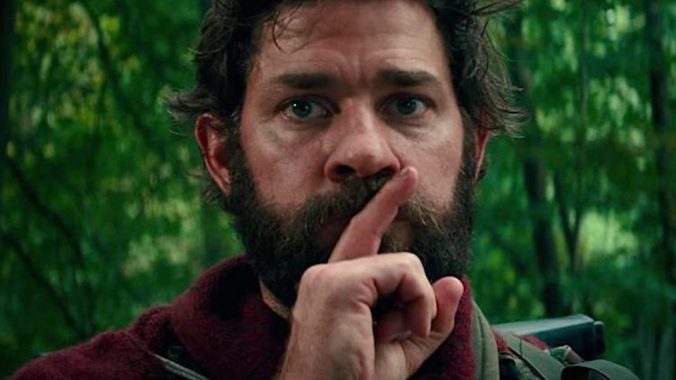
A friend of mine once said he has a principle: that the true measure of a movie is how much you can remove its gimmick and still be left with something special. It’s a good rule of thumb, and like any rule regarding movies, it’s made to be broken—it’s perfectly possible to double down on high-concept premise so wildly that there’s no need for niceties like meaningful drama. A Quiet Place, this year’s horror sleeper hit, directed by John Krasinski, is nothing if not high-concept. In a post-apocalyptic future, vicious monsters (aliens? mutants?) have invaded and almost exterminated mankind. The hook is that the monsters, while seemingly indestructible, can’t see, but can hear the slightest sound. So a surviving family, played by Krasinski, his real-life wife Emily Blunt, and a duo of children-in-peril, have to scrape by in near-total silence, communicating by sign language and watching every step. It’s all an excuse for jump-scares, for squeezing fear out of otherwise ordinary environments, and for the quiet place to be suddenly rattled by a frenzied set-piece. (One involving red lights and fireworks does very well).

Yet I can’t help but think of the aspects of its concept left unexplored. Consider the psychological implications of never being able to speak, laugh, or cry after a lifetime of doing so. Consider that it had gone on for a year, and there’s no sign that you’d ever get it back. It’s enough to drive any sane person mad, even without aliens or mutants. And then consider that A Quiet Place is almost entirely unconcerned with such psychology. The film’s engine is more the usual combo of physical danger and underlying family pathos—and given the movie’s achievements, which include ruling the spring box office and getting green-lit for a sequel, that might be for the best. It is the psychological aspects of a horror movie that really have the potential to disquiet an audience; the rest is just for fun.

So this is slumber party stuff, through and through: some frights, some showdowns, some drama, some surprises, some light squeamishness, and some triumph, never breaking the boundaries of PG-13 while getting in and out in 90 minutes. The fact that $188 million worth of American ticket buyers were captivated by so little talking speaks not just to all the visual hand-holding but to the draw of a good clean fright night. In my experience, it’s the genre where young moviegoers are most likely to roll the dice on a novel pitch. On that level, it works, capitalizing on its ambitions by taking them only so far. Even its stretches of implausibility can’t rightly be chastised as flaws. They’re more like conversation pieces for a monster-movie audience—something for you and your friends to fondly joke about after the show, having been engaged for the duration, pleasantly goosed, and able to sleep soundly.

✬✬✬✩✩

*********

A Quiet Place is now available on home video and streaming. I don’t know why I keep seeing outlets refer to this as John Krasinski’s directing debut—it seems kind of unfair to the two features he directed before it.

Short Cuts: DOUBLE LOVER

double-lover

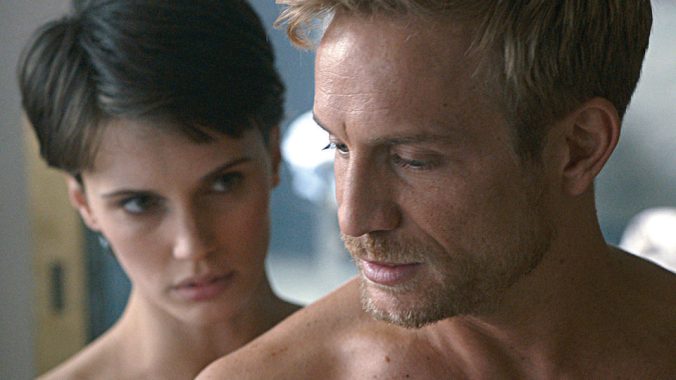
The first thing you see before the opening title of Double Lover, the new thriller by François Ozon, is its young star getting her long hair cut very short. As she throws away one look for another, she seems strangely agitated, and when she makes eye contact with the camera, there’s something of an instant challenge to anyone staring back. Is she preparing to play a role? Having a mental breakdown? Or simply getting her hair done?

The first thing you see after the opening title is an extreme close-up of her vagina. The scene is a trip to the gynecologist, and it is, by design, among the least erotic nudity you’ll ever witness. But for a movie in which sex and intimacy play such leading roles, it’s a way of immediately and squeamishly giving you the most physically private sight of its heroine possible and letting her stay no less an enigma when she comes out the other side.

There is intrigue in such gamesmanship, in a director playing with what we see and what we know. This approach, not to mention the plot built around it, finds Ozon in De Palma territory: doppelgängers, split-screens, and lethal unreliability. In an apparent state of physical and psychological pain, the heroine (Marine Vacth) visits a therapist (Jérémie Renier) to pour out her subconscious. She starts a love affair with him in an emotionally unhealthy sort of way, and then learns that—unless she’s imagining things—he has a twin brother with a nastier and kinkier streak. It’s a solid concept for a character study doubling as a mystery, or vice-versa. It has its stylistic flourishes—mirrors abound—and a heartfelt destination in mind. But the intrigue starts to wane when the film, god help it, has to find ways to sustain its middle hour in that dangerous duality of pretension and camp.

And here, Double Lover is useful mainly as a case study in the difference between Good Ridiculous and Mediocre Ridiculous. As the sexy bad twin, Renier comes across less as a force of irresistibly dangerous masculinity and more like a 50 Shades of Grey impersonator for bachelorette parties. The film’s in-the-streets, in-the-sheets psychoanalysis is thumpingly literal, bluntly scripted, and visualized in ways that seem like the stuff of underfunded art school projects. Set it next to something like De Palma’s Obsession or Dressed to Kill or Femme Fatale (which are no less insane) and you can see what Double Lover is missing: a more skilled and dextrous command of what film can accomplish as a dream state. Double Lover tells you straight out too much of what it should be implanting subconsciously. It makes disbelief something you have to suspend rather than something you’re happy to throw away, and in the process breaks and continually recasts its own spell. Late-game body horror elements mean that anyone who picked out the film for purely lustful reasons will get exactly what they deserve. But forbidden desire needs to transform its excesses into the audacious kind of wit that Double Lover keeps losing control over. The good people at Cohen Media had the devilish sense to premiere the film in American theaters on Valentine’s Day. It’s almost the wittiest thing about it.

✬✬✩✩✩

*********

Double Lover played in the main competition at Cannes in 2017 and came out on US home video this summer. I can’t say I recommend doing so, but if you can safely watch it with your significant other, you have a very healthy relationship.

Short Cuts: THOROUGHBREDS

thoroughbreds

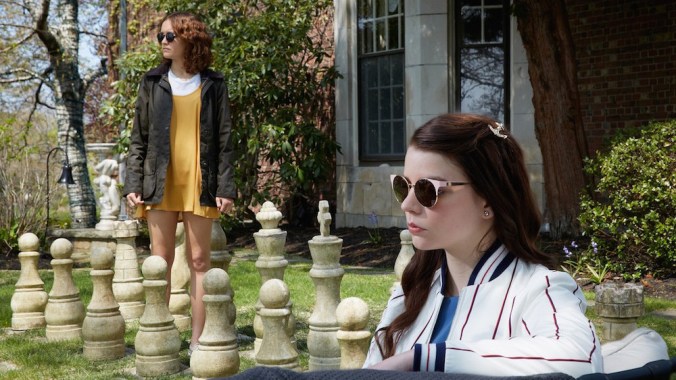
The sociopathic elite haven’t changed much since the 1980s—or at least, there are still people willing to take Bret Easton Ellis’s Less Than Zero as a trenchant critique rather than a zeitgeist-y piece of knee-to-the-gut prose. Thus, riding out of Sundance, comes Cory Finley’s Thoroughbreds, about two teenage friends (Olivia Cooke and Anya Taylor-Joy) who plan to murder the latter’s stepfather.

In part, they do so because the stepfather is an unpleasant man. But it’s more because, ensconced in a world of privileges, the anti-heroines are too affluent, too imbalanced, or too disaffected to have much perspective on human life. Cooke’s character is recovering from a scandalous, rumor-inducing breakdown. Taylor-Joy appears to have more composure, but can’t hold it for long. And the film that unfolds is less a valuable examination of American wealth than a dour, self-serious take on a soap opera staple: beautiful rich people doing awful things. From the dialogue alone, you can tell that the action is set somewhere in Connecticut or near Westchester County. I grew up in one and went to high school in the other, and god knows there’s enough material there to keep a satirist busy for a lifetime. But this particular cinematic murder is so very high-concept in its construction, so surface-level in its observation, and simultaneously so vague in its central metaphor and so unsubtle in its overall meaning.

What remains, then, is the simple pleasure of a plot that keeps you wondering who will be killed and whether anyone will face the consequences—and that simple pleasure is not unsatisfying. Between Cooke as the psycho version of the sarcastic girl you always kind of liked in high school and Taylor-Joy looking perpetually like she knows something she won’t say, the two have an icily engaging chemistry. The film needs their bond, because that bond is far sturdier and more human than the plot mechanics. The rest is filmmaking craft that generates mood from very few moving parts, but whose aspirations still lean towards knee-to-the-gut bluntness and whose aim is less than precise. It is a movie—a real movie-movie, with technique, contrivances, and all—that struggles with whether it is, or wants to be, or should be, as detached from the world as its subjects.

✬✬✬✩✩

*********

Thoroughbreds is now available on Blu-ray and as a digital rental. It’s always nice to have noir where you grew up.

Short Cuts: YOU WERE NEVER REALLY HERE

you-were-never-really-here

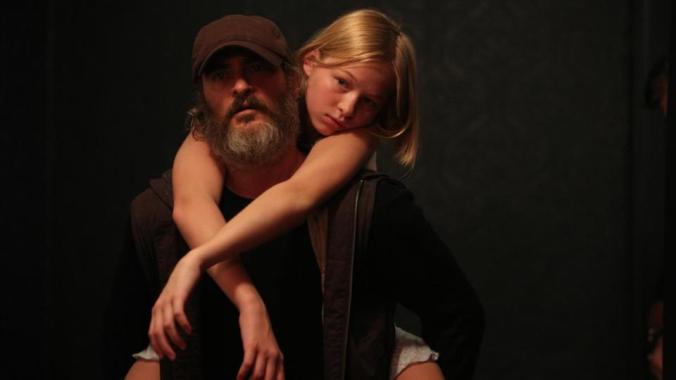
We last saw Scottish director Lynne Ramsay at a place of organized chaos: 2011’s We Need to Talk About Kevin, a deeply uncomfortable, sensory-assaulting narrative montage that dropped us directly into the head of arguably the strangest character Tilda Swinton has ever played. That Ramsay went so long without another feature was not according to plan. Rather dramatically, she quit the director’s chair of the Natalie Portman western Jane Got a Gun on the first day of production. Lawyers descended—Hollywood has chaos of its own.

With You Were Never Really Here, Ramsay returns, dialing back but not abandoning the chaos of Kevin for a lean, intense 90-minute thriller that retains her taste for haunted subjectivity. That haunted subject here is Joaquin Phoenix, starring as a bounty hunter who specializes in rescuing children from sex trafficking rings. Much of his performance lies in physical transformation: the character is part action hero and part wreck, muscle-bound but lumpen, showing a layer of flab and a paunch, his hair an uncombed tangle and his face obscured by a mangy beard. Physically, he seems fairly impervious to pain, as action heroes are. Psychologically, it’s clear that, whatever wound he hopes to heal by doing what he does, it isn’t working. But he’s good at it, and so is Ramsay. She and her team do well with the simple art of cinematic murder: the placement of a dying man, or a pair of broken glasses, or a hallway with something dreadful around the corner, is all very meticulously composed. (The plot bears surface similarities to Taxi Driver, but a more direct Scorsese link is the way Ramsay sets a scene of Joaquin Phoenix beating men with a hammer to the tune of a classic pop song).

The real question is whether the film finds an adequate social and psychological context for its action—that is, if it can transcend being an exercise in sophisticated, aestheticized violence. That question deserves an answer both passionate and ambivalent, because some of the film can fall into the arthouse trap of looking or seeming more artistic than it is. But between Phoenix keeping a low volume and Ramsay’s taste for flash cuts, it opens itself nonverbally; like the film’s troubled, introverted hero, the camera keeps catching details that echo and resonate. The coup, I think, comes in the withheld nature of the climax, which twists the conventions of a salvation-through-heroism arc both cleverly and soulfully, and suggests that perhaps genre tropes, Scorsese’s needle-drops included, are enough of a social context of their own. On those terms, it works fantastically as one of the better films of 2018—a film whose existence examines different kinds of detachment. And so it understands the multiple connotations of the title: a movie-hero covert operative, a dissociated trauma victim, and a lonely soul who, in the scheme of things, may not even make a difference. Its setting may be the dark city of film noir, but pair it on a shrewd double bill with Shane or The Searchers, and you might realize that Ramsay got to make a western after all.

✬✬✬✬✩

********

You Were Never Really Here is available on home video and Amazon Prime. Cheers to their distribution arm for treating films right.

Short Cuts: UNSANE

unsane

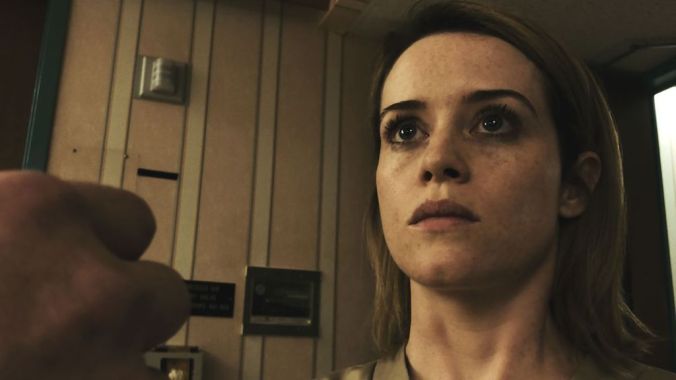
Could Steven Soderbergh ever really retire? Our most prolific and eccentric of Hollywood insiders rather suddenly announced his retirement five years ago, and cooler heads cautioned us to wait and see. The retirement turned into a “sabbatical”, which turned into directing two seasons of The Knick. His hiatus from feature films officially ended after four years—i.e., the average time we wait for a non-retired Paul Thomas Anderson to make a film—with last summer’s Logan Lucky. And even if you missed it, which I did, you didn’t have to wait long for his next release: Unsane, a thriller shot quickly and in secret on an iPhone 7.

Its horror roots are as old as Dr. Caligari: a woman who may or may not be crazy gets involuntarily committed to a mental institute where someone may or may not be after her. From there, it descends from clammy to lurid, stopping along the way for Soderbergh’s recurring theme of money as the blood pumping through America’s veins. But the less revealed, the better, because a large part of the film’s suspense is whether its pieces will actually come together or go flying decadently off the rails. As a genre experiment, it uses the idiosyncrasies of its tech to wonderfully eerie effect: the digital grain, the blooms of light, the warping of the depth of field, the uncanny clarity of an HD close-up with little or no makeup—everything that seems “off” is very much in the film’s service. The choice of format and framing can put you at an almost immediate unease, and so many unbalanced compositions feel like miniature prisons of their own.

Like most Soderbergh films, it doesn’t swing for the fences; its aspirations are to tinker, needle audience expectations, and provide entertainment for perversely curious cinephiles who wonder how the idea of “a movie” (one with a narrative, a genre, a star, etc.) can end up on screen feeling like such an anomaly. It works as well as it does because it’s the sort of potboiler that wouldn’t want higher production values if you offered them and would roll its eyes at you, as contemptuously as its heroine, if you asked if it was “art.” But there’s a long, storied history of respected filmmakers being influenced by disreputable, low-budget pulp. So if you’re wondering what a 21st century equivalent of those cult 1950s/60s/70s B-movies would be—brash, formally inventive, so trashy in some ways but clever in others, bouncing progressive politics off of pure exploitation—Unsane is it. So get a phone and get cracking; formal control is cheap.


Short Cuts: THE DEATH OF STALIN

death-of-stalin

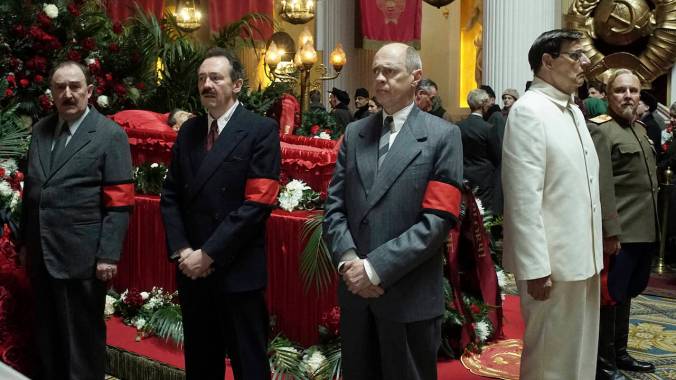
In The Death of Stalin, Steve Buscemi plays Khrushchev. He doesn’t sound like Khrushchev—he sounds like Steve Buscemi. He doesn’t look like Khrushchev—he looks like Steve Buscemi with a shaved head and a prosthetic nose. And all of this is very much to the film’s appeal. When addressing recent history, particularly real-life figures who already have sizable media footprints, a drama has to overcome that nasty, hairy thing called verisimilitude. But comedy can whack verisimilitude across the face with a rubber chicken and still get at the truth, especially if the truth is absurdity.

The director is Armando Iannucci, and anyone familiar with his previous work—BBC’s The Thick of It, its 2009 spinoff movie In the Loop, and his leap to America with HBO’s Veep—will know what to expect: a comedy set in entrenched government bureaucracy, where ships of state are manned by hapless, childish, recognizably human fools whose convictions are spotty and who can only try their best to avoid a very British kind of embarrassment. Only here, the stakes are raised, because we are in the dead center of Soviet power grabs, and such embarrassments are staged with violent round-ups going on in the background. In our own time, when anxious leftists might wonder if incipient authoritarianism is too incompetent to succeed, a pitch-black political comedy is a deliciously dangerous prospect: an uncomfortable reminder that it’s perfectly possible to trip and fall ass-backwards into a dystopia.

This makes the The Death of Stalin as disappointing as it is clever, because it is not nearly the movie it could be, especially given the talent involved. The verbal flow that never stopped crackling in In the Loop and The Thick of It has become repetitive in comparison. The style has shifted from on-the-fly, quasi-documentary chaos to the semi-ironic production values of a “serious” period piece, and it leaves the film halfway towards limbo. The comedy lacks the consistency of Iannucci’s best work, the intrigue lags far behind the banter, and the pivot from dark laughs to terror isn’t seamless, as if the film’s distance from its characters and narrative is torn between short skits and dire consequences.

What that leaves you with is a long string of nice touches, like a stock scene of two politicos conspiring as they stroll through a park, only to pass by two others doing the same; or Michael Palin giving a rambling speech that leaves a table full of yes-men teetering back and forth, confused whether he wants them to vote yay or nay. The Death of Stalin feels more sincere and well-observed in such little human absurdities than it does when the time comes to face history, and I wonder if Iannucci’s lens is best suited to a mundane republic rather than a dystopian dictatorship. In the end, I’m not sure we have anything more than we started with, not even a fully satisfying realization of the idea that authoritarian regimes, like sitcom plotlines, tend to reset back to zero after the last one has ran its course. If drama has its pitfalls, so does comedy, and satire faces the challenge of somehow acting glib and provoking engagement at the same time. Make no mistake, The Death of Stalin has barbed moments that tease and wink and bite—enough to be worth the price of admission. But I wish the frenzy of the film could match, let alone illuminate, the satire playing out in every day’s headlines.

✬✬✬✩✩

*********

The Death of Stalin is available to rent on iTunes, where their curators made it an Editor’s Choice. Godspeed.