Short Cuts: WIND RIVER

Wind River - Still 4

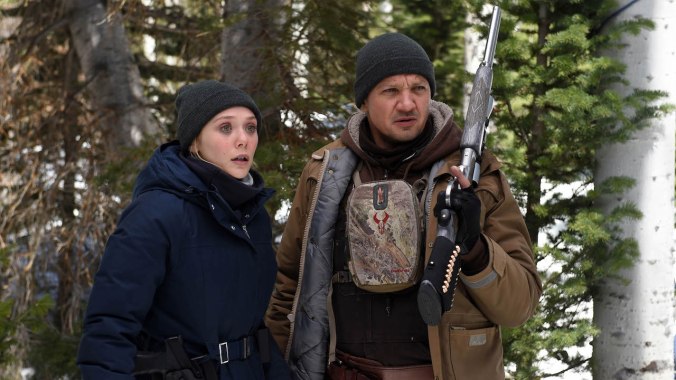
When filmmaker Taylor Sheridan was last in theaters, it was as the writer (but not director) of last year’s Oscar-nominated Hell or High Water. I didn’t shine to that film as much as some of my friends or the Academy; it was a solid western noir script, but the presentation of it felt too glossy by half. That is, for its tale of crime and punishment in the American heartland, I could never quite shake the feeling that I was watching movie stars play-acting for a camera. Wind River, his follow-up and his first time directing his own script, takes its atmosphere a step in the right direction simply by being more stark. It feels brought down to the soil, even if the soil is under three feet of snow.

Old Hollywood has its own tradition of borderland noir—Touch of Evil (1958), Ride the Pink Horse (1947), etc.—and Wind River aspires to work a twist on that fear of lawlessness by being set on America’s border with itself. Or to be more specific, an Indian reservation, with all the federal neglect that entails, where Native Americans mingle with the white inhabitants of a nearby Wyoming town, and where a local hunter (Jeremy Renner) and a green FBI agent (Elizabeth Olsen) have to solve the murder of a Native American teen, found dead in the snow miles from the nearest anything. The murder mystery itself is completely linear, but I’d wager that’s not a poverty of imagination so much as a sad-eyed interest in inevitability. Sheridan remains a fine observer of the heartland, with a good ear for dialogue, an ability to add personal nuances to characters who might otherwise fade into cliche, and a strong sense for a version of American life that’s a million miles away from the Westwood Village, where I saw the film.

There is, I think, a certain obviousness that mars the film: an obvious mystery, an obvious rape-revenge resolution, and an obvious cinematic style, limited to a few mood-setting chords and anonymous handheld photography. Sheridan has room to grow as a filmmaker, but he knows how to keep a plot clipping along, when to drop the thematic hammer, and how details can turn a corpse into more than a mere procedural. Wind River‘s interest is in different kinds of American society, where new generations make their stand on top of old legacies, and where the past should neither determine fate nor be forgotten. And on those counts, Wind River lands some inspired touches and fine climactic monologues. Its overt social conscience toward modern Native American life is undercut, or at least complicated, by the fact that the hero relied on to mete out justice is a white man, treated cinematically as a kind of cowboy and Indian rolled into one. But in one of the keener details, we see that his Native American ex-wife is raising their mixed race son on a track of upward mobility, pointed towards bigger towns with better pay and better schools. And I like to imagine they’ll be moving on while he’s content to stay. Like any good revenge story, it seems mournfully hesitant at the idea that the present can ever truly set the past right. But it’s smart enough to keep one eye cagily trained on the future.

✬✬✬✬✩

********

Wind River is still haunting a few second-run theaters. You can download it legally by the end of the month.
Halloween Countdown: THE WICKER MAN

wicker-man

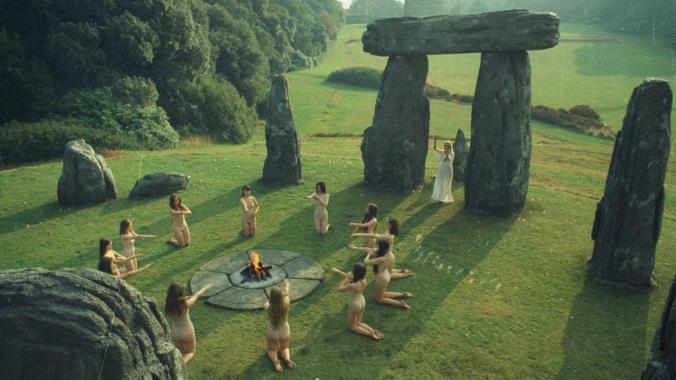
Last year, I started a personal Halloween tradition of posting reviews of 20 horror movies on my Facebook. The idea was to write them short, fast, and colloquial, no proof-reading allowed, and only for an audience of friends—which, at the time, was more fun and only slightly less lucrative than being a freelance film writer in Brooklyn. This year, I port the tradition over to my blog, and to kick off the Halloween bash in the name of weird costumes, cult rituals, pop paganism, and director Robin Hardy, who passed away last year, we turn our morbid gaze to his original 1973 The Wicker Man.

Among American millennials, The Wicker Man may be best known for a quite awful Nicolas Cage remake that got distilled into a quite hilarious, context-free viral YouTube highlights reel. But the original has an imposing reputation for genre fans. First released alongside Nicolas Roeg’s Don’t Look Now in the double bill of every British paranoiac’s dreams, The Wicker Man has been poured over, acclaimed, restored, and recreated as a Radiohead music video. But the mystery still maintains a spooky intrigue of its own, even if it doesn’t quite live up to its rep.

On a remote Scottish island sinister enough that Christopher Lee is in charge, and kinky enough that Britt Ekland is always up for whatever, a devout Christian police inspector arrives to investigate the report of a missing young girl. It soon becomes apparent that a conspiracy is afoot, and that the old druidic ways of superstition and godless sex have taken over this isolated community. Our Hero comports himself with a certain lack of awareness, slow to catch on to just how much danger he’s really in. Is it sloppy writing, or is it just that Our Hero stubbornly believes enough in Jesus Christ and Her Majesty the Queen to assume no one would dare touch him? Either way, as it death-marches to its finale, The Wicker Man is less an airtight mystery thriller than a kind of religious parable for happy nihilists.

It’s also a masterclass in threatening coziness, in the ways that the ruddy, friendly faces of a rural town can creep you the hell out. (A lesson that Edgar Wright, one of the film’s on-the-record cultists, surely picked up on for Hot Fuzz). In many ways, remaking it in the 21st century seems like a sketchy idea to begin with, not just for all the obvious reasons, but because The Wicker Man is so much rooted in its time and place: the post-counterculture hangover of the early 70s. The central conflict is essentially a battle between a conservative establishment and a libertine commune that makes up rules of its own, and the film’s sneakiest coup is that both ways of living your life come across as utterly unappealing. So take the ride, because it has a prime horror movie ending. And if that prime horror movie ending bums you out, you can always pick yourself up again by heading to YouTube and watching Nicolas Cage scream about the bees.

✬✬✬✬✩

********

Halloween Countdown is an annual, personal, and highly unoriginal tradition where I write fast, extemporaneous reviews of 20 prominent but random horror movies during the month of October.

Short Cuts: IT COMES AT NIGHT

it-comes-at-night

It Comes at Night first came to my attention over the summer, when a writer for the Guardian coined (or tried to coin) the term “post-horror”, to describe not only It Comes at Night, but other recent releases like Personal Shopper and A Ghost Story. Here were films that borrowed iconography and plot elements from the horror genre—and maybe even had a scare or two—but whose pacing and focus on cosmic, spiritual, or existential concerns made them more at home in an arthouse or on the festival circuit than in Netflix’s Horror carousel. Once the term “post-horror” hit the hivemind of the internet, a lot of genre fans rightly called bullshit, and they have two good reasons for doing so. First, because the term implies that there’s something about the genre that needed a high-minded corrective—”isn’t it about time?” said the Guardian—when directors like Brian De Palma and George Romero were able to put provocative subtext or sophisticated craft into packages a hell of a lot schlockier than any of the movies listed above. And second, because the traits of a “post-horror” film (an emphasis on poetic visuals, dreamy pacing, and cosmic/spiritual/existential concerns over conventional frights) aren’t really new to the genre at all, a small cluster of them in a few months notwithstanding.

But if there’s one value of the term “post-horror” trying to be forced into existence, it’s in how it draws attention to the way such films are marketed, and to the gap between critics’ and audiences’ perception of them. To the extent that any film’s reception can be numerically quantified—and isn’t that what the internet keeps trying to do with everything?—there’s no doubt that there seems to be a gap between “the critics” (RottenTomatoes) and “the people” (IMDb, CinemaScore, etc.) when it comes to It Comes at Night. As for whether it’s the movie’s fault, or just that weekend audiences who pay to see a horror flick want something less cryptic and more viscerally immediate, I think in this case they can split the difference.

So how is the film? Pretty good, so let it never be said an enterprising filmmaker can’t end the world on a tiny budget. Set in a world where a plague has wiped out most of human civilization, an interracial family tries to scrape by in their house in the woods. The son is troubled by nightmares, the (white) father protects them with a cold, tribal pragmatism. When they agree to let in another, much more more noticeably happy family, the tense truce that ensues builds to a bloody climax. For most of its runtime, it’s a mood piece, trying to make a cramped wooden house as atmospheric and unpredictable as the Overlook Hotel, with varying results. Frustration can be understandable, since the film’s sparse scene-by-scene storytelling suffers from a certain vagueness: a vague post-apocalyptic scenario and a vague “it” stalking the woods yield a vague allegory—something about American isolation, something about paranoia, maybe something about race—that, like many films from the indie sphere, feels like a strong concept that had to be padded to reach 90 minutes. It is only in the third act that the vagueness starts to lift, at least thematically, leading to a terrific payoff for anyone who doesn’t insist that stories be tidy. The biggest mystery is an open chasm, but there’s something rewarding about its core: a traumatized young boy whose dream sequences have a hint of prophesy, but who is ultimately unable to change the direction of the narrative at all. It’s enough to mark writer-director Trey Edward Shults as a talent to watch: a filmmaker with ideas awaiting a more robust treatment. Here’s rooting for him.

✬✬✬✩✩

*********

It Comes at Night is available to rent on iTunes. Beware of red doors.