Short Cuts: THE LOST CITY OF Z

lost-city-of-z

Is there any Hollywood director working today with a bigger gap between cinephile regard and general public indifference? The films of James Gray aren’t often given a wide release, don’t get a push for Oscar season, and have shockingly low IMDb scores considering their caliber. But there are many cinephiles who will swear up and down that he’s one of American cinema’s greatest assets, with films like We Own the Night (2007) and Two Lovers (2008) as treasures too subtle for proper recognition.

The idea of classicism tends to figure into discussions of Gray’s work, and just for fun, I did a search of how often the word “old-fashioned” appeared in articles about his latest film, The Lost City of Z, in theaters now. I found results from the New York Times, Vanity Fair, Slate, IGN, IndieWire, and AllMovie before I decided I’d better get on with writing an article of my own. The use of the word is not wrong. But it raises the question of why the old-fashioned nature of Gray’s cinema seems to be a barrier for modern audiences, while movies like, say, The Grand Budapest Hotel (2014) or La La Land (2016), which are much more explicitly built from the pieces of old art, manage to catch a kind of zeitgeist. The best answer I can give is that what’s old-fashioned in Gray is not so much an aesthetic but a philosophy, and one that’s devoid of pretensions towards self-conscious hipness or modern irony. So it’s satisfying that, when approaching The Lost City of Z, which is indeed old-fashioned, I can’t cleanly peg the movie as an emulation of another director. There’s a bit of Cimino, certainly—The Deer Hunter (1978) and the good parts of Heaven’s Gate (1980). Coppola, maybe? David Lean? The ghost of Michael Powell? But in the end, the film feels most of all like his, and his alone.

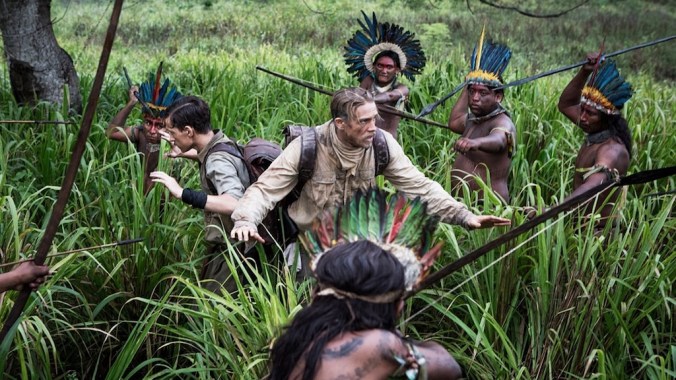
Any short plot summary of The Lost City of Z will tell you that it’s about an early 20th century explorer—Percy Fawcett, a real historical figure—on an obsessive upriver quest to find a rumored ancient city in the Amazon rainforest. This elevator pitch is only about 40% true, but it’s also the only specific information you should have when you enter the movie, so the film can slowly dawn on you as a carefully layered story about the passage of time, where moments from the beginning rhyme at the end, and where a wife you first thought might be a stock character turns out to have an arc of her own. The film is devoted to filling a CinemaScope frame and getting the proper effect from an epic runtime. It offers itself for comparison to Werner Herzog’s two trips to Amazonia, Aguirre: The Wrath of God (1972) and Fitzcarraldo (1982). The difference is that Gray’s hero doesn’t want to conquer the world but merely to understand it, which is an idea simultaneously less grand and more universal. Like Zodiac (2007), it is a case study in how to tell a “true story” when no one knows the ending. And there’s no better solution than to take that uncertainty into the real of symbolism and dreams.

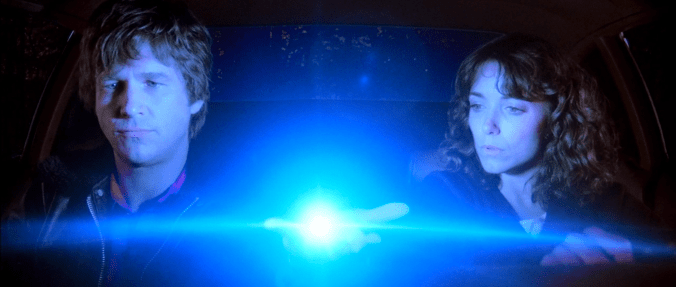
So at the risk of angering Gray’s fans and confusing everyone else, I think it’s no insult to say that Gray’s strong suit here, as with his last film The Immigrant (2013), is not plot. Does he get his characters from A to B seamlessly? Does The Lost City of Z, for instance, truly sell the scene where Charlie Hunnam’s explorer goes instantly from being a cynic to a true believer in cities of gold after finding a broken pot next to a tree? Storytelling is by nature at least partly an act of salesmanship. But salesmanship is not an idea we associate with purity, and purity is Gray’s most old-fashioned aspiration. The most satisfying arcs in his films are thematic, emotional, and metaphorical—in other words, appreciating them requires a certain earnest belief that a film can arrive at simple moment, or a gorgeous image, or a look on a character’s face and still carry such a meaningful catharsis. And that’s an idea that, I fear, much of today’s moviegoing culture would be happy to roll its eyes at. (I remember once going with a friend to The 400 Blows (1959), and he didn’t see why the ending was anything more than a young boy standing on a beach). There are purely mechanical problems with The Lost City of Z. The dialogue often merely tells you its plot points or its character’s emotions without coming to life with the wit or vitality of a good wordsmith. A slightly thin set-piece on the battlefields of World War I shows that Gray’s skill set is not the same as Spielberg’s or, er, Mel Gibson’s. But it’s been 48 hours, and I keep thinking of how many different things The Lost City of Z is about. Its final shot still hasn’t left my mind.
✬✬✬✬✩

Short Cuts: THE BFG

null

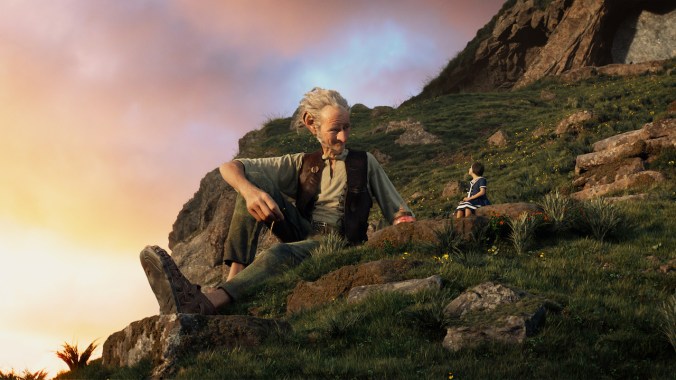
I like Steven Spielberg and I like Roald Dahl, so when The BFG opened last summer to middling reviews and box office numbers that could be politely described as “disappointing”, the bad buzz didn’t faze me. Spielberg can find a valuable voice when he zooms in on a lonely child—E.T. (1982), Empire of the Sun (1987), A.I. (2001)—and the idea of a reunion with E.T. screenwriter Melissa Mathison to make an old-fashioned kids movie sounded enticing. So after reading several industry think-pieces about how the Spielberg brand might not appeal to audiences as much as it used to, I decided to see the movie. I was living in New York City at the time, and it was during a heat wave, one of those hot, ungodly humid summer days where the city air feels thick and every subway station is like the world’s filthiest sauna. I walked around Prospect Park to get to the theater and arrived feeling unpleasantly like I was about to pass out. I asked for a ticket for The BFG, and the girl behind the counter said, “Are you sure?” It turns out, the air conditioning had broke in one of their screens, so they’d moved The BFG to the Room With No Ventilation and kept the rest running as normal. I decided it wasn’t meant to be, bought a drink from a Mister Softee truck, and spent my ticket money on taking a cab home. The think-pieces were onto something.

But now The BFG is streaming on Netflix, available to all current subscribers at a very reasonable marginal cost of $0, so I dipped in. And I exited the film the way I began it: wondering whether or not making an “old-fashioned kids movie” is even possible today, given that a certain level of technocratic bombast comes as a summer movie prerequisite. Aside from being a Disney film, you should also note the involvement of the production house Walden Media, which was set up with the admirable goal of recreating the feeling of children’s lit in children’s films. They’ve had a hand in adapting such school library classics as The Chronicles of NarniaCharlotte’s Web, Holes, and Bridge to Terabithia, and I’ve often noticed a somewhat schizoid pull in their films between the modest, gentle nature of a good children’s book and the way that, after Lord of the Rings, everything needs to be epic.

The BFG is not a disaster, but it is a film that must be approached as a gleaner, sifting through the spectacle and occasional cheap gag (like a crotch joke writ large) for several wonderful moments that inspire thinking/feeling rather than drowning them out. There is an admirable elegance to the way Spielberg’s camera swoops and whooshes through the green-screened sets. The two actors who occupy most of screen (a motion-captured Mark Rylance and a spunky young Ruby Barnhill) are both excellent. The emotional core, about dreams being captured and delivered to children, is certainly up Spielberg’s alley. And when he let’s lyricism take over—always his most underrated strength—he captures scenes worthy of the enterprise. The part that will turn most people off is also the one that best captures the movie’s head-scratching contradictions: an awkward, extended set-piece near the end built around farting in Buckingham Palace. Despite any knee-jerk reaction to blame Spielberg or Disney, I can assure you that farts belong to Dahl—as a writer, he grasped that children are much ruder than their parents might wish them to be. But the difference between how such scenes play out on page and screen is a cautionary tale if there ever was one. The idea of farting in front of the Queen may have been subversive in a book, particularly when delivered by right proper British parents reading to their children at night. Visualized on screen, with all of 2016’s worst tendencies for oversaturated live-action cartoons, it’s scarcely less crass than its more cynical competition. Which is to say, whether it’s a battle between giants or a monster-child friendship or a Quentin Blake drawing or the world’s most committed flatulence joke, there are aspects of children’s literature that movies will always have to be careful about tackling, lest the might of a nine-figure budget be easily outpaced by a slim paperback written at a 4th grade level.

✬✬✬✩✩

Short Cuts: AFTER THE STORM

after-the-storm-2016

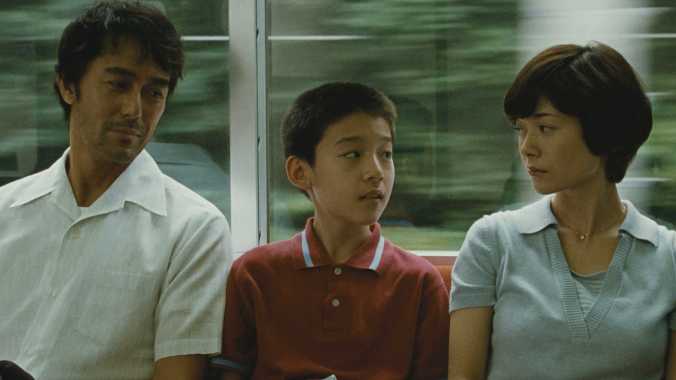
These days, it seems that films by Hirokazu Kore-eda come and go like seasons. That is, much like each spring or each summer, each Kore-eda family drama is both immediately comparable to and distinct from the one before it, and lingers, blurry, in the memory the same way. (This latest one played at Cannes last May, and is filtering through American arthouses now). As every review is more or less obligated to mention, Kore-eda owes a conscious debt to the masterpieces of Yasujiro Ozu, whose own string of family portraits from the 40s to the 60s—often titled after seasons, for that matter—are among the most revered/fetishized films in cinema history. Though he lacks the dextrous subtlety found in Ozu’s best work, Kore-eda borrows much from the late legend: the stillness of the camera, the contemplative rhythm, the unending context of daily life, the focus on different generations of a family unit, and a somewhat oblique or even indifferent approach to the idea of “plot”. Any plot summary of After the Storm might say that it’s about a loving but damaged family sharing space under a roof during a typhoon, but by the time the typhoon arrives, well into the movie, you’ll have gathered that the “storm” of the title is really a divorce. Ozu fans might spot a fleeting reference to someone named “Noriko”, the same name as Ozu’s immortal heroine who was always in want of a husband, and the quick nod exists if only to ask what becomes of Ozu’s recurring theme of marriage traditions at a time when marriage can be less an institution and more a relationship with built-in impermanence.

So where to begin? Kore-eda’s hero is a private detective and erstwhile writer stuck on his next novel—he’s a late-bloomer, his family optimistically puts it—while nursing a gambling addiction and generally struggling to act like a responsible adult. He and his wife have split, he only infrequently gets to see his son, and a new man has entered the picture. You could play a strange Hollywood parlor game with all the ways this material—a detective spying on his ex, a rebuilt father-son bond, a family divided but forced into close quarters—could power everything from screwball comedy to melodramatic schmaltz. (Indeed, one of Kore-eda’s last films, the exquisite Like Father, Like Son (2013), had American remake rumors swirling around it a few years ago, so we may get to see such theories in action). But Kore-eda is more interested in character than plot, in details over incidences, in acceptance over climax. Why else, for instance, would he include several asides about the hero’s widowed mother taking lessons on classical music—a strand that has no conflict, let alone resolution—except to show that life always goes on? And so After the Storm is both a story and a group of people you get to know, spotting their problems, their dynamics, their reasons. In the film’s smartest stroke, the family’s patriarch has recently passed away, and unless I blinked at the wrong time, you never see his image at all—no photos, no recordings—but slowly come to grasp how the flaws of that unseen man have been passed down. It is a humble film in scope, but paradoxically, it’s also the first new release I’ve seen this year made with the old-fashioned belief that a movie can reveal something meaningful about the human experience. That’s not to say it fully succeeds, or that expecting a truly profound epiphany for $12 isn’t a lot to ask. But if you’re willing to slow down, it is a work of lovely miniaturism, dotted with moments of grace, sadness, and small triumph. Key line, spoken by a minor character: “For better or worse, it’s part of my life.”

✬✬✬✬✩

Short Cuts: PERSONAL SHOPPER

MV5BM2YzZDZjZmUtMWVmOC00OTc0LWJmMTItMzU2ZTQ5OTI1M2RkL2ltYWdlL2ltYWdlXkEyXkFqcGdeQXVyNjUxMzg2Mzk@._V1_SX1777_CR001777999_AL_

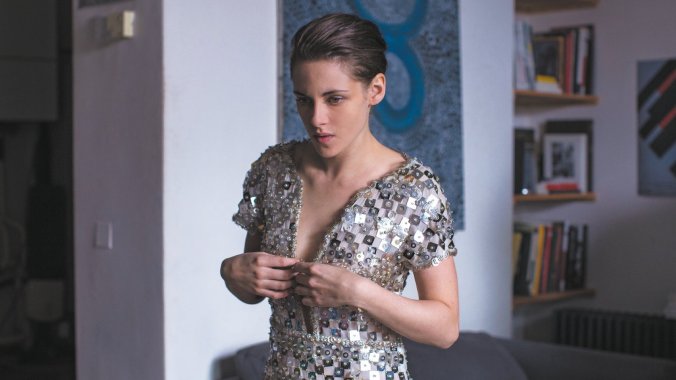
Let’s go back in time about 8 years: as the Twilight movies reach peak cultural saturation, Kristen Stewart becomes a full-blown tabloid celebrity and is quickly memetized by the internet as the girl with a vacant stare, a tendency to bite her lower lip, and such a bland personality that it’s a wonder that Edward/Jacob/whoever want to fight over her. So it may surprise my college friends to hear that there’s a modest cinephile movement brewing—at least, in some corners—to claim her as a terrific talent. She recently set a record as the first American actress to win a César (the French Oscars), for her performance in Olivier Assayas’s excellent Clouds of Sils Maria (2014). And Assayas himself—an auteur’s auteur who has had a standing invite to Cannes since the 90s—called her nothing less than “the best actress of her generation.” Last year, the BAMcinématek in Brooklyn did a series on Stewart called “Bad Reputation”, an in-joke to the time Stewart played Joan Jett in The Runaways (2010) and a gentle encouragement for all the New York cinema hipsters to take the Twilight girl more seriously. I dipped into the series, and left feeling not that Stewart was a great actress, but that, at best, she’d been cast by some very talented directors. Film acting is a funny thing. The legendary director Robert Bresson, for instance, was famous for referring to his actors as “models”; that is, he picked performers, professional or non-professional, who had a look he could build a movie around. I don’t think Stewart can convincingly emote or consistently disappear into a character, but she does have a look. (Her best role—or at least, the one that most plays to her strengths—is in Kelly Reichardt’s Certain Women (2016)).

Now Assayas and Stewart have teamed up again for Personal Shopper, a film that got a divisive reaction at Cannes last year (some boos, some applause, and a top prize from the jury) and has quietly slipped into American theaters for the curious and the confused. And to be honest, I’m not sure the material is suited to either of them, even if it’s brave of them to try. The film is something of an arthouse ghost story, though most of all it exists to confound genre labels. Film is an art form where seemingly unrelated elements can be placed side by side and allowed to play off each other in coy, thematic ways. And so Stewart’s character gets two storylines: in the first, she’s the titular “shopper” (an invisible, poorly treated assistant) for a wealthy socialite in Paris, and in the second (stay with me here), she’s a medium trying to contact the soul of her dead twin brother. What do the two have to do with each other? The movie and its details offer food for thought, certainly—like the contrasts/parallels between hunting for ghosts and sending personal text messages to an anonymous stranger, or between being dead and working at the fringe of the red carpet, or between today’s hottest fashion and an unknown artist who stands the test of time. But Stewart comes across as fussy when she explains the spirit world, as if she doesn’t believe this bullshit herself, and Assayas’s ghost story itself spends most of the movie in limbo, somewhere between the compelling ridiculousness of a good B-movie and the serious tragedy that allows high-minded horror to pull it off. So the film is most successful when Stewart’s character is enigmatic rather than expressive, and when Assayas leaves you wondering which direction the film will go next, as it moves from horror to melodrama to meta-meditation to thriller and back to horror again. For those who like movies with details, it can keep you guessing right up to the moment you realize it leaves you with less than it wants.

✬✬✬✩✩

Short Cuts: SONG TO SONG

Song to Song

Terrence Malick has made more films in this decade than he did in the four that preceded it, and it would be all too easy to say that his speed after The Tree of Life hasn’t done him any good. To the extent the movie-going world noticed them at all, 2012’s To the Wonder and 2015’s Knight of Cups divided the cultists from the workaday cinephiles and revealed the dangers of Malick’s working method. But in their defense, accusations of self-parody overlook not only what those movies actually have to say, but the way Malick is still evolving. So while the usual suspects will say he’s repeating himself, I say he’s searching. All the modern-day pilgrims that dot his newfound productivity make me see him as something of a pilgrim himself: working on variations of a theme, looking for a new kind of “Terrence Malick film”.

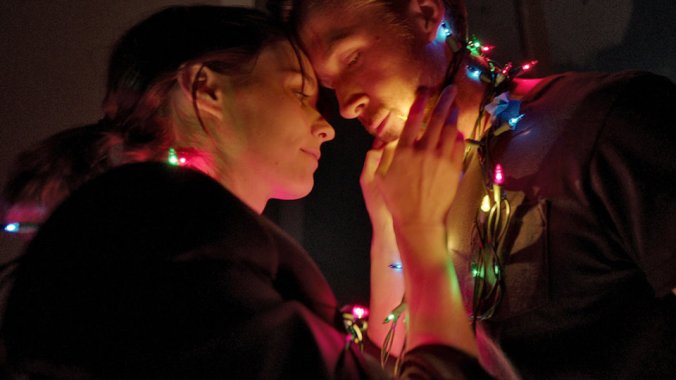
So here are the numbers on his latest film Song to Song, a drama (read: two-hour montage) about love triangles in the Austin music scene. It’s currently playing in 4 theaters in the country (to disappointing box office receipts). The theater I saw it at—a mall multiplex, of all places—was about 20% full, mostly older couples. And at least three couples walked out. Yet Song to Song does represent a progression, if not necessarily an improvement, on the films before it. For one, and unlike Knight of Cups or To the Wonder, Song to Song feels like a story first and a spiritual allegory second. It’s heavier on plot, and it contains his most interesting characters since Tree of Life, particularly Rooney Mara. He’s finding better ways to shoot the modern world, including a few captivating guerrilla filmmaking sequences. The confessional voice-over is more emotionally raw and less strained towards poetic grandiosity. And the looseness of his structure, when paired with the subject of youth, picks up a certain energy, as if Malick’s improvisational style were getting closer to the riffs and twirls of the New Wave. As his free-spirited young heroes dance, fuck, split, and get drawn by necessity back to the old-fashioned values they lack, it struck me that depending on how you read his attitude towards aimless bohemians—and there’s a lot of wiggle room—Malick’s moral philosophy could be a good deal simpler than his cinematic dexterity. But there are too many beautiful shots to name, and some of them, like a climactic long take of Mara and Ryan Gosling driving, provide an emotional catharsis better than conventional drama ever could. Those who hate Malick will see more of the same: a self-important editing brew not worth decoding. As for Malickians, they’ll shine to it. A new Malick film is no longer a continent of its own but a miniature piece of a larger whole. Here’s hoping he finds what he’s searching for.

✬✬✬✩✩

Short Cuts: LOGAN

logan-still-1

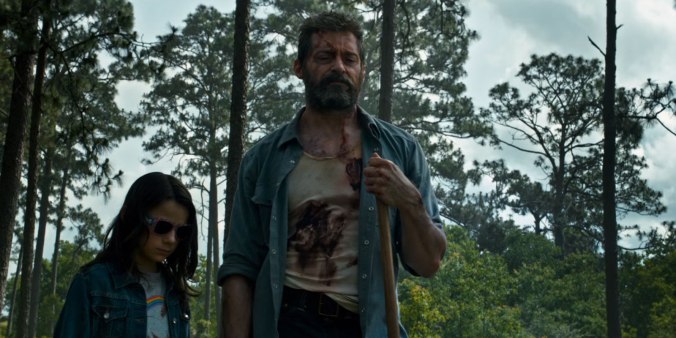
I lost track of how many Hugh Jackman Wolverine movies they’d made somewhere between 2009’s X-Men Origins: Wolverine and 2013’s just plain The Wolverine, and in the 17 years since it kicked off the superhero gold rush, the X-Men cinematic universe has expanded, split, and folded back on itself. But as one final berserker rage, Logan is satisfying for a good reason: it understands that, at a time when blockbuster heroes can get thrown through a wall without losing their breath, you can raise the stakes simply by making your characters vulnerable. Most comic book movies are bloodless in both the literal and poetic senses of the word, and Logan gets an emotional effect by showing you your favorite heroes as their bodies and minds deteriorate, not to mention the jarring feeling when they mix their old routines with words like “shit” and “fuck”. (It earns its R rating—I’m sure that aghast, confused parents abound). And this gets to the vagueness at the crux of the movie: Logan takes great pains to step outside its own franchise and say that the real world—or at least, the real world of Logan—isn’t like a comic book. In fact, it says so rather directly and repeatedly, and is littered with details of counter-programming: a no-superhero-names-allowed title, a stark setting, a small cast for a franchise that typically revolved around teamwork, an extended reference to the classic revisionist Western Shane (someone must have already written a think-piece comparing the two), a relatively minimal use of CGI spectacle, and lots of blood and dismemberment. But I’m not convinced that Logan really offers any true commentary or revision of the comic book movie. Its world isn’t any more “real” just because it throws around F-bombs and severed heads; all it does is swap one movie myth for another. (Howard Hawks for Sam Peckinpah, say). But as movie myths go, it’s an entertaining one. I’m sure someone involved played through The Last of Us.

✬✬✬✬✩